AI Gridlock: The Infrastructure Problem that Might Derail the UK's AI Ambitions

Duncan Clubb

SUBSCRIBE CONTACT US

Author


Introduction

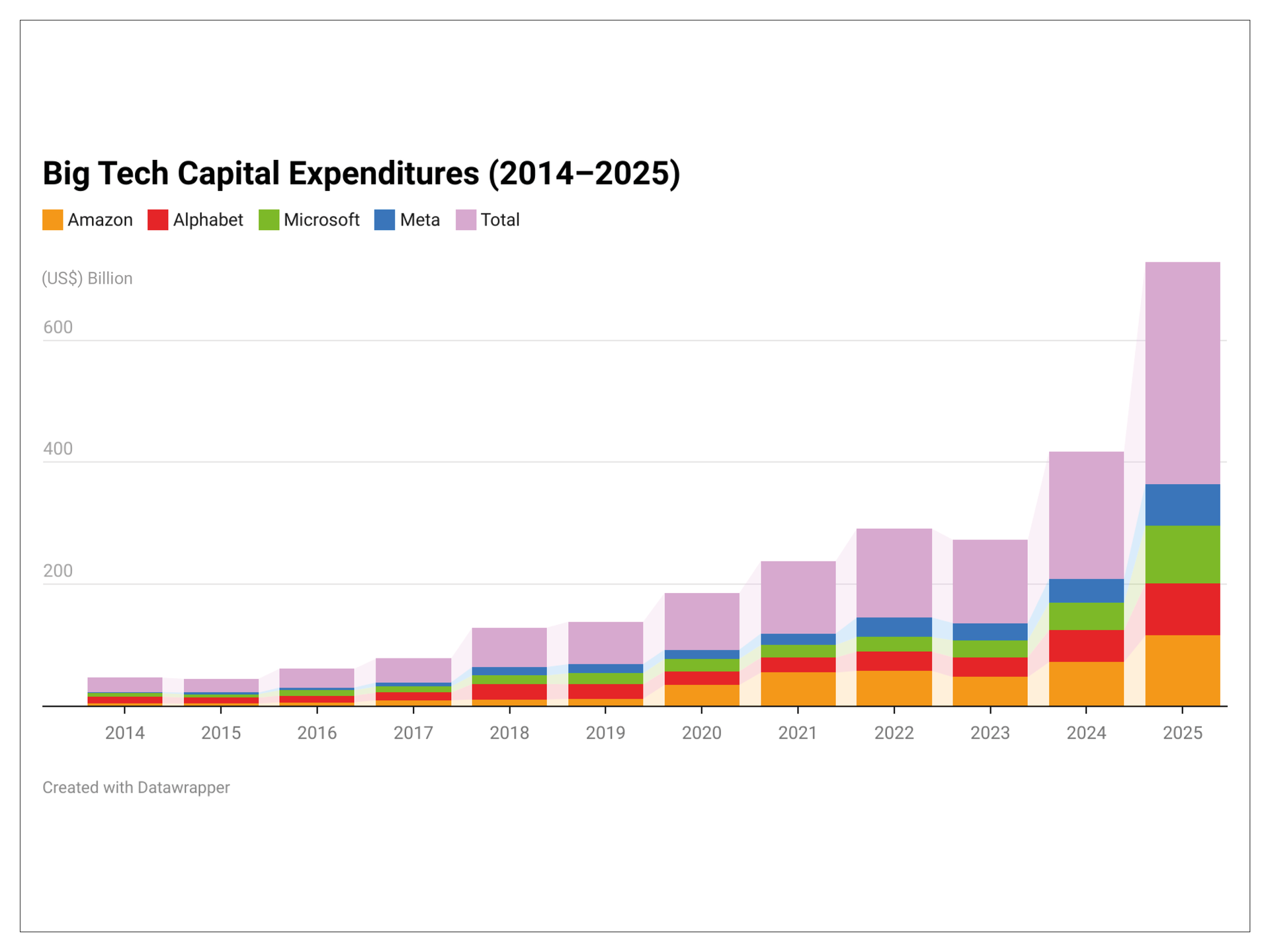
Vast sums are being invested into AI infrastructure by big tech. In 2025 alone, the largest US companies have spent more on AI than the US government has on education, training, employment and social services. The bulk of this Capex investment has been spent on data centres and expensive semiconductor chips made primarily by Nvidia. 


Data centres consume huge amounts of power and (sometimes) water, creating upstream infrastructure problems. The tech giants are taking care to ensure they will have enough energy. As well as hybrid partnerships with energy companies, tech firms are investing in new nuclear facilities and renewable off-grid sources. 


The UK has entered a similar AI race, just will less zeros at the end. Ironically, it is also being led by US companies, although there are some homegrown firms in the mix too. This national boom will have huge implications for a known bottleneck in the system, the National Grid. 
Hungry for Electricity

The data centres being planned in the UK today are on a much larger scale than we have ever seen before. Decades ago, large data centres used 2-4MW. Today, the UK’s biggest runs at 120MW. 


For context, a town or city the size of Cambridge might consume about 80MW. Planned AI data centres will start at 500MW and could reach GW scale. Unfortunately, the National Grid is creaking at the seams; this is particularly evident in London. Currently, there are very few places in the UK where you can deliver that much power, and you could be waiting many years for new grid infrastructure to be made available. 


The UK has another big challenge: the price of electricity. Even at wholesale rates, our electricity is probably the most expensive in Western Europe. We generate some of the cheapest renewable electricity in the world, but national pricing is skewed by gas. This makes it difficult for data centre operators to compete with other European locations which can supply large amounts of cheap, renewable energy - the Nordic countries in particular are considered as prime locations for AI data centres.


There are however a slew of government initiatives and policies intended to update the grid and solve these infrastructure barriers.

AI Growth Zones

A centrepiece of the UK’s strategy is the creation of ‘AI Growth Zones’ - special zones with favourable conditions for AI infrastructure. Announced in the AI Opportunities Action Plan (Jan 2025), these zones are intended to accelerate data centre build-out. Regions across the country have been invited to bid to host AI Growth Zone. 


Each zone will offer streamlined planning approval (fast-tracking permits) and guaranteed power availability. In fact, the government has pledged to work with network operators to rapidly provide 500 MW+ of power per zone. While this is promising, it should be noted that the huge data centres in these regions will take at least five years to build, and this leads us to another problem: rack density. 

Rack Density

The rate at which we can build data centres is out of pace with the acceleration of AI technology. Nvidia, the leading supplier of AI processors, is constantly upgrading its products. This rapid development means data centres designed today may be outdated by the time they are built. 


The key issue here is what we call ‘rack density’. Data centres house computers in racks or cabinets, usually about 1m wide, a bit over 1m deep, and 2m tall. Pre-AI, the global average ‘density’ for a data centre rack was 8kW - in other words, each rack could accommodate up to 8kW of electricity consumption (and cooling). 


Nowadays, some AI data centres are running at 50kW per rack. The current top-end Nvidia systems need upwards of 120kW/rack. They have announced that the next generation (expected in 2026) will run at 600kW/rack. This presents a huge challenge, as operators must feed 600kW into something the size of a cupboard.

Conclusion

The UK’s strategy for electricity supply is to plan ahead and invest: by channelling data centre growth to places with ready power, by massively upgrading grid infrastructure, and by reforming regulations to connect new sites faster. 


Huge challenges remain - for instance, Microsoft has warned that without swift grid upgrades some of its UK data centres might wait until the mid-2030s for full power connection. Experts warn of a disconnect between UK AI ambitions and timely power access. 


However, the ongoing measures - from 500MW growth zones and new substations to national grid investment plans - indicate a concerted effort to ensure the lights stay on for Britain’s AI revolution. The government’s Plan for Change aims to tackle these constraints so new AI centres can be plugged in, enabling the UK to realise its AI ambitions.

Get in Touch

If you want to find out more about our Data Centre, Edge and Cloud services and how we can help you plan and execute projects across your portfolio, then get in touch with Duncan by email or use the Contact Form below.


Find out more about our Data Centre services on our service page.

Contact Form

Contact - Craig Devolution Blog

Subscribe to our Newsletter

Blog Subscribe

SHARE CONTENT

Pembroke College lawn bathed in sunlight
by Tim Passingham 12 March 2026
CAMBRIDGE | See how Cambridge MC and Pembroke College are creating mutual value through a unique corporate partnership spanning student opportunities, academic collaboration and industry events | READ FULL CASE STUDY
Neon sharks made out of code.
by Simon Crimp 9 March 2026
Cyber Security | Ransomware in 2026 is a board-level resilience issue. Learn the key risks, weak spots and practical questions boards should ask to improve readiness, recovery and response.
The Top 21.2026 at the awards event in Cambridge, UK.
6 March 2026
The #21toWatch Top21.2026 winners have been announced at an awards ceremony at The Glasshouse innovation hub in Cambridge.
Asian business woman near a long window and looking at a tablet.
by Arianna Mortali 6 March 2026
BLOG | A student’s perspective on why women shouldn’t have to ‘play masculine’ to succeed at work – and how valuing empathy, confidence and inclusive leadership can help close gender gaps and build healthier organisations.
Abstract squiggle of circles
by Simon Crimp 19 February 2026
Where should leaders start with AI in 2026? A practical guide to moving beyond pilots, clarifying risk appetite, strengthening governance, improving data readiness, and delivering measurable enterprise value from AI at scale | READ FULL ARTICLE
Close up of a data centre stack with ports and wires visible
12 February 2026
We were approached by one of the fastest growing data centre providers in Europe. With over 20 data centres throughout the continent, they are consistently meeting the need for scalable, high-performance infrastructure. Despite this, a key data centre in Scandinavia had become reliant on a single, non-redundant 1 Gbps internet service from a local provider, posing significant risks to operational continuity. To enhance the reliability of its network and resolve these risks, our client needed to establish additional connectivity paths to ensure the redundancy of its infrastructure. The Ask Cambridge Management Consulting was engaged to address these connectivity challenges by identifying and evaluating potential vendors and infrastructure options to create second and third connectivity paths. This involved exploring various types of connectivity, including internet access, point-to-point capacity, wavelengths, and dark fibre. Additionally, Cambridge MC was asked to provide recommendations for building a local fibre network around the data centre to control and maintain diverse paths. This would allow the data centre to connect directly to nearby points of presence (PoPs) and reduce dependency on external providers, thereby enhancing network resilience and operational control. The goal of this project was to ensure that the Nordic data centre could maintain continuous operations even in the event of a failure in the primary connection. Approach & Skills Cambridge MC approached the project with a focus on ensuring operational continuity and resilience for the data centre. By identifying multiple connectivity paths, we aimed to mitigate the risk of network failures and ensure that the data centre could maintain continuous operations even in the event of a failure in the primary connection. This approach allowed Cambridge MC to provide a comprehensive solution to address both immediate and long-term connectivity needs. We employed a combination of Agile and Waterfall methodologies to manage the project. The initial investigative phase allowed a Waterfall approach, in which our team conducted thorough research and analysis to identify potential vendors and connectivity options. This phase involved detailed interviews with various telecommunications providers and an assessment of publicly available information. Once the initial analysis was complete, the workflow transitioned to an Agile approach for the implementation phase. This allowed Cambridge MC to adapt to new information and feedback from stakeholders, ensuring that the final solution was both flexible and robust. Challenges Lack of information: One of the primary obstacles we faced was the lack of detailed network maps and information from some of the potential vendors. To overcome this, the team conducted extensive interviews with contacts at these companies and leveraged its existing network of industry contacts to gather as much information as possible. Remote location: Another challenge was the remote location of the data centre, which limited the availability of local infrastructure and required us to explore creative solutions for connectivity. Cambridge MC addressed this by proposing the construction of a local fibre network around the data centre, which would allow for greater control and flexibility in connecting to nearby PoPs. Fragmented factors: Additionally, coordinating with multiple vendors and ensuring that their services could be integrated seamlessly posed a logistical challenge. We mitigated this by recommending a phased approach to implementation, starting with the most critical connectivity paths and gradually expanding to include additional options. Outcomes & Results Increased Connectivity: Cambridge MC successfully identified and evaluated multiple connectivity paths for the data centre. By exploring various types of connectivity, including internet access, point-to-point capacity, wavelengths, and dark fibre, we provided a comprehensive solution that significantly enhanced network resilience and reliability. Greater Control & Flexibility: Our recommendations for building a local fibre network around the data centre allowed for greater control and flexibility in connecting to nearby points of presence, ensuring continuous operations even in the event of a failure in the primary connection. New Vendors: The team’s extensive network of industry contacts and deep understanding of the regional telecommunications landscape allowed for a thorough and nuanced evaluation of potential vendors and connectivity options. Scope for Future Work: Cambridge MC identified several future developments with the potential to further enhance international connectivity and provide additional redundancy for the data centre. We also proposed further assistance, including a site visit for a more in-depth analysis of options, issuing RFI/RFP to vendors for capacity and fibre, and conducting similar connectivity studies for other candidate sites in the region.
Neon discs fading from blue to green to purple, cascading diagnolly across the screen.
by Cambridge Management Consulting 28 January 2026
Thames Freeport this week revealed the eight companies selected to participate in the Freeport’s Connectivity Lab, an initiative focused on validating commercially proven technologies in live port and logistics environments.
Aerial view of a data centre warehouse in the English countryside
by Duncan Clubb 13 January 2026
Author
by Matt Lawson 2 January 2026
Emerging as a hub for innovation, Thames Freeport is a unique initiative designed to stimulate trade and transform the lives of people in its region. Leveraging global connectivity and occupying a strategic position with intermodal capabilities across river, rail, and road, Thames Freeport has recognised its opportunity to drive economic regeneration for the local area. Thames Freeport engaged Cambridge Management Consulting to design a clear strategy for innovation over the next three to five years. Key considerations for this innovation strategy included objectives and KPIs, the future of the business ecosystem in the region, physical clusters and assets such as innovation hubs, and opportunities and challenges on the way. The Solution Working with our innovation partner, L Marks, Cambridge MC conducted an innovation strategy project which involved the following: Engaging with a range of stakeholders and partners from local authorities to corporate partners across the Thames Freeport area, leveraging interviews with key individuals to build a common picture of innovation aspirations, opportunities, and challenges. Conducting a series of workshops for the Thames Freeport team to consider visions and objectives, themes and focus areas, physical hubs and overall programme structure, and a three-year roadmap plan. Building a comprehensive innovation strategy which internalised all of the above questions. This was then presented to their board and formed the basis of the public tenders for innovation programmes that were then made public. 
More posts