
Case Study: Navigating Cloud, Content & Telecoms Markets in the UK

Duncan Clubb


Subscribe Contact us

How Cambridge MC helped Virgin Media Business Wholesale Fibre develop a deeper understanding of the UK CCT market


Virgin Media Business (VMB) engaged Cambridge MC to help build an overview of the Cloud, Content and Telecoms market and ecosystem in the UK. Hundreds of companies comprise the CCT market, including many international players.


The links between companies like VMB, who provide the fundamental infrastructure that the CCT market sits on, and the end-users of their services create a complex ecosystem. The space is constantly evolving and new technologies such as Artificial Intelligence (AI) and Edge applications are introducing new requirements that the various operators and service providers must cater for in the future.


The Ask


The CCT ecosystem is complex and is constantly growing. New entrants are emerging all the time and new applications and services are being driven by new technologies and services, all of which are driven by new demands from a very diverse user base—commercial, industrial and consumer markets are all evolving extremely rapidly.


Understanding how it all fits together provides new insights for sales and marketing teams to use in positioning their products. VMB challenged Cambridge MC to produce a single infographic that encapsulated the ecosystem and its most important elements. 


To accompany the ecosytem map, VMB commissioned a report on the UK market and the key drivers influencing change and evolution in the ecosystem.


The Solution


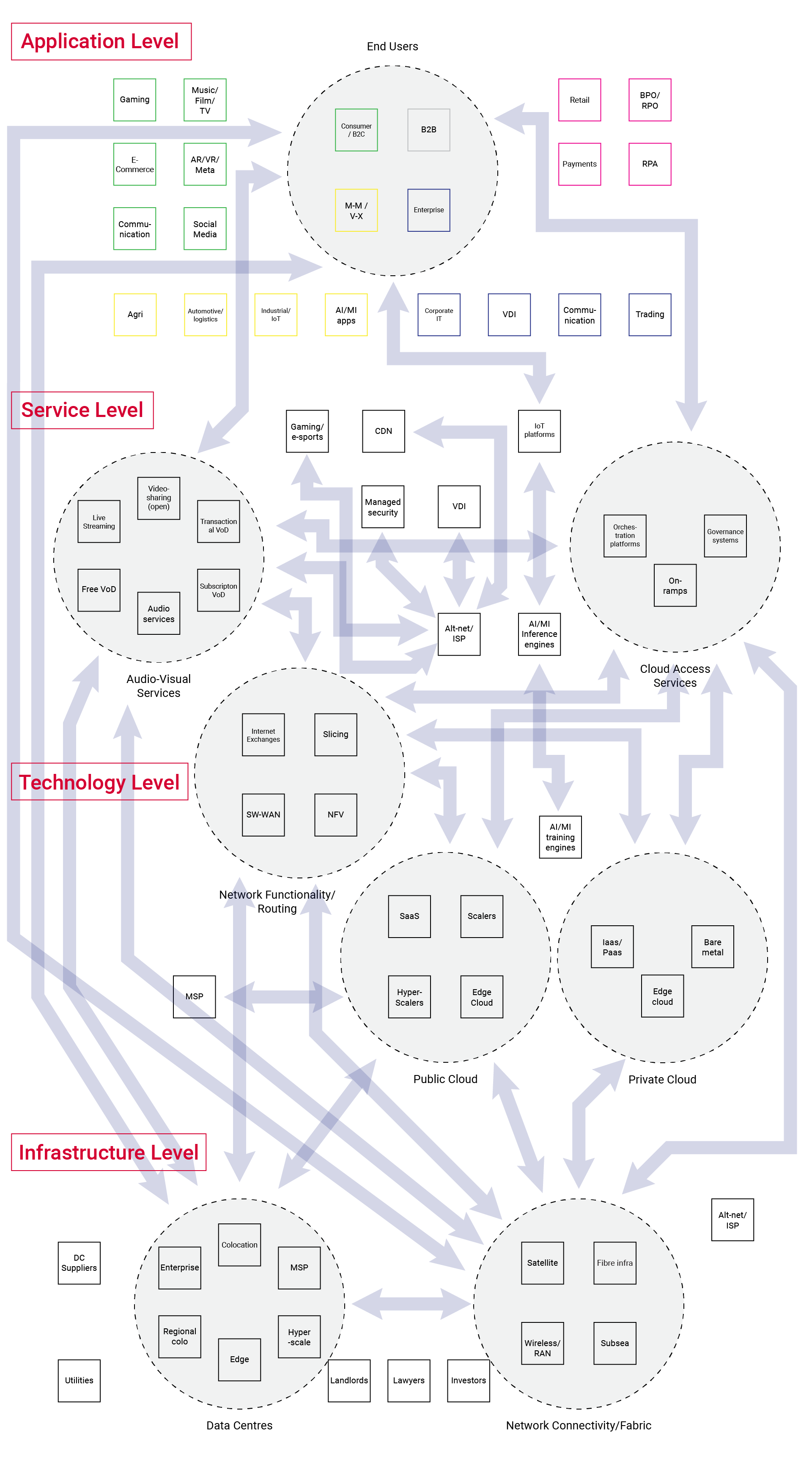
Cambridge MC produced a single infographic (a much simplified version of it is shown below) that showed the UK market divided into 4 layers, each of which serves the layers above and/or below. The end-users at the Application Layer drive all the demand — this is where data is generated and consumed. The Service Level provides end-users with sophisticated and aggregated services, such as streaming or cloud access services. In turn, this layer relies on a Technology Layer of cloud compute/storage systems and network services. Underpinning all of this is the Infrastructure Layer which includes fibre networks and data centres.


Within the lower three layers, Cambridge MC identified 24 groups of participants with over 45 different company profiles, all of whom are participants in the ecosystem. The infographic also showed how revenue tends to flow at a macro level between the players in the market.


The study also included a written report on aspects of the UK fibre and data centre markets from both the perspective of the data centre operators and providers of network services. The purpose was to give VMB guidance on strategic developments in the UK markets, based on short- and long-term trends.


The study looked at the potential impact of emerging technology trends, including adoption of large-scale AI systems and deployment of distributed Edge platforms in markets outside of the usual hubs in the UK.


The CCT Map
Outcomes & Results


1. CCT Ecosystem Infographic

We completed the challenge set by Virgin Business Media to represent the entire CCT ecosystem in a single infographic, showing the data flows across 4 layers, from source to end-users, via a multitude of intermediaries.


2. Report on the UK CCT Market

A comprehensive report on the UK fibre and data centre markets from both the perspective of the data centre operators and providers of network services. It showed VMB the major players and emerging technology trends in the CCT ecosystem.


3. Insights

Both the infographic and written report gave VMB strategic insights into the CCT market in the UK, allowing them to tailor their product design and marketing to match the needs and future expectations of end-users in commercial, industrial and consumer markets.
Case Study

Get in touch with Our Consultants today


Contact - AI at the Edge article

Subscribe to our Newsletter

Blog Subscribe

SHARE CONTENT

Yello and turquoise neon lights.
24 March 2026
International consulting firm, Cambridge Management Consulting has acquired telecommunications cost-reduction specialist, The Carrier Club, strengthening its ability to help organisations reduce their telecoms and network infrastructure costs.
Pembroke College lawn bathed in sunlight
by Tim Passingham 12 March 2026
CAMBRIDGE | See how Cambridge MC and Pembroke College are creating mutual value through a unique corporate partnership spanning student opportunities, academic collaboration and industry events | READ FULL CASE STUDY
Neon sharks made out of code.
by Simon Crimp 9 March 2026
Cyber Security | Ransomware in 2026 is a board-level resilience issue. Learn the key risks, weak spots and practical questions boards should ask to improve readiness, recovery and response.
The Top 21.2026 at the awards event in Cambridge, UK.
6 March 2026
The #21toWatch Top21.2026 winners have been announced at an awards ceremony at The Glasshouse innovation hub in Cambridge.
Asian business woman near a long window and looking at a tablet.
by Arianna Mortali 6 March 2026
BLOG | A student’s perspective on why women shouldn’t have to ‘play masculine’ to succeed at work – and how valuing empathy, confidence and inclusive leadership can help close gender gaps and build healthier organisations.
Abstract squiggle of circles
by Simon Crimp 19 February 2026
Where should leaders start with AI in 2026? A practical guide to moving beyond pilots, clarifying risk appetite, strengthening governance, improving data readiness, and delivering measurable enterprise value from AI at scale | READ FULL ARTICLE
Close up of a data centre stack with ports and wires visible
12 February 2026
We were approached by one of the fastest growing data centre providers in Europe. With over 20 data centres throughout the continent, they are consistently meeting the need for scalable, high-performance infrastructure. Despite this, a key data centre in Scandinavia had become reliant on a single, non-redundant 1 Gbps internet service from a local provider, posing significant risks to operational continuity. To enhance the reliability of its network and resolve these risks, our client needed to establish additional connectivity paths to ensure the redundancy of its infrastructure. The Ask Cambridge Management Consulting was engaged to address these connectivity challenges by identifying and evaluating potential vendors and infrastructure options to create second and third connectivity paths. This involved exploring various types of connectivity, including internet access, point-to-point capacity, wavelengths, and dark fibre. Additionally, Cambridge MC was asked to provide recommendations for building a local fibre network around the data centre to control and maintain diverse paths. This would allow the data centre to connect directly to nearby points of presence (PoPs) and reduce dependency on external providers, thereby enhancing network resilience and operational control. The goal of this project was to ensure that the Nordic data centre could maintain continuous operations even in the event of a failure in the primary connection. Approach & Skills Cambridge MC approached the project with a focus on ensuring operational continuity and resilience for the data centre. By identifying multiple connectivity paths, we aimed to mitigate the risk of network failures and ensure that the data centre could maintain continuous operations even in the event of a failure in the primary connection. This approach allowed Cambridge MC to provide a comprehensive solution to address both immediate and long-term connectivity needs. We employed a combination of Agile and Waterfall methodologies to manage the project. The initial investigative phase allowed a Waterfall approach, in which our team conducted thorough research and analysis to identify potential vendors and connectivity options. This phase involved detailed interviews with various telecommunications providers and an assessment of publicly available information. Once the initial analysis was complete, the workflow transitioned to an Agile approach for the implementation phase. This allowed Cambridge MC to adapt to new information and feedback from stakeholders, ensuring that the final solution was both flexible and robust. Challenges Lack of information: One of the primary obstacles we faced was the lack of detailed network maps and information from some of the potential vendors. To overcome this, the team conducted extensive interviews with contacts at these companies and leveraged its existing network of industry contacts to gather as much information as possible. Remote location: Another challenge was the remote location of the data centre, which limited the availability of local infrastructure and required us to explore creative solutions for connectivity. Cambridge MC addressed this by proposing the construction of a local fibre network around the data centre, which would allow for greater control and flexibility in connecting to nearby PoPs. Fragmented factors: Additionally, coordinating with multiple vendors and ensuring that their services could be integrated seamlessly posed a logistical challenge. We mitigated this by recommending a phased approach to implementation, starting with the most critical connectivity paths and gradually expanding to include additional options. Outcomes & Results Increased Connectivity: Cambridge MC successfully identified and evaluated multiple connectivity paths for the data centre. By exploring various types of connectivity, including internet access, point-to-point capacity, wavelengths, and dark fibre, we provided a comprehensive solution that significantly enhanced network resilience and reliability. Greater Control & Flexibility: Our recommendations for building a local fibre network around the data centre allowed for greater control and flexibility in connecting to nearby points of presence, ensuring continuous operations even in the event of a failure in the primary connection. New Vendors: The team’s extensive network of industry contacts and deep understanding of the regional telecommunications landscape allowed for a thorough and nuanced evaluation of potential vendors and connectivity options. Scope for Future Work: Cambridge MC identified several future developments with the potential to further enhance international connectivity and provide additional redundancy for the data centre. We also proposed further assistance, including a site visit for a more in-depth analysis of options, issuing RFI/RFP to vendors for capacity and fibre, and conducting similar connectivity studies for other candidate sites in the region.
Neon discs fading from blue to green to purple, cascading diagnolly across the screen.
by Cambridge Management Consulting 28 January 2026
Thames Freeport this week revealed the eight companies selected to participate in the Freeport’s Connectivity Lab, an initiative focused on validating commercially proven technologies in live port and logistics environments.
Aerial view of a data centre warehouse in the English countryside
by Duncan Clubb 13 January 2026
Author
More posts