5 Questions to Help SMEs with Their Cyber Security

Tom Burton


Subscribe Contact us

SMEs make up 99% of UK businesses, three fifths of employment, over 50% of all business revenue, are in everyone's supply chain, and are exposed to largely the same threats as large enterprises. How should they get started with cyber security?


Small and Medium sized Enterprises (SME) are not immune to the threat of cyber attacks. At the very least, if your business has money then it will be attractive to criminals. And even if you don’t have anything of value, you may still get caught up in a ransomware campaign with all of your data and systems made inaccessible.


Unfortunately many SMEs do not have an IT team let alone a cyber security team. It may not be obvious where to start, but inaction can have significant impact on your business by both increasing risk and reducing the confidence to address new opportunities.


In this article we outline 5 key questions that can help SMEs to understand what they need to do. Even if you outsource your IT to a supplier these questions are still relevant. Some can’t be delegated, and others are topics for discussion so that you can ensure your service provider is doing the right things, as well as understanding where their responsibilities stop and yours start.


Q1: What's Important & Worth Defending


Not everything needs protecting equally. In your personal life you will have some possessions that are dear to you and others that you are more laissez-faire about. The same applies to your digital assets, and the start point for any security plan needs to be an audit of the things you own and their importance to your business.


Those ‘things’, or assets, may be particular types of data or information. For instance, you may have sensitive intellectual property or trade secrets; you may hold information about your customers that is governed by privacy regulations; or your financial data may be of particular concern. Some of this information needs to be protected from theft, while it may be more important to prevent other types of data from being modified or deleted.


It is helpful to build a list of these assets, and their characteristics like the table below:

REF Name Description Impact Where Sensitivity
1 Finances Accounting and financial planning documents If modified or deleted we would be unable to produce accurate reports for tax and may fail to meet customer contractual obligations. Xero Finance SharePoint Accountants Very High
2 Product IP Product designs, future feature roadmaps, source-code If stolen we would lose competitive advantage. If modified defects or vulnerabilities could be inserted causing our service to malfunction or putting our customers at risk. GitHub Cursor All High
3 Customers Customer registration and order details If stolen we would lose customer confidence and may be subject to fines and/or lawsuits. If modified we may be unable to meet customer contractual obligations. HubSpot Sales SharePoint Email High
4 Employees Employee records including payroll and tax details If stolen we would put our employees are risk and may be subject to fines and/or lawsuits. If modified or deleted we may be unable to pay our employees on time. Xero HR SharePoint High
5 Marketing Future marketing plans, market segmentation data, campaign content and plans If stolen we may lose competitive advantage. If marketing content was modified it could damage our reputation, put our customers at risk, and may lead to lawsuits. Website Marketing SharePoint Medium

You may also have other assets that are critical systems your business couldn’t operate without. For example, you may have a computer controlled manufacturing system and would start losing significant revenue if it stopped working for more than a week.


This asset list is unique and personal to your business. This isn’t something that can be delegated or outsourced to an IT service provider. They will most likely be unaware of the assets you use, and will certainly be unable to assess their criticality to your business. By spending some time developing this asset register you will be in a better position to decide what needs protecting and to what extent.


Q2: Are Your Users' Accounts Being Protected?


Your employees need to be able to access your assets in order to do their jobs. You finance staff need to access financial data, and your marketing team needs to be able to work on their campaigns. But because they can usually access sensitive data, if those user accounts were hijacked this same data will be fully accessible to the bad actor as well. This is why its so important to reduce the likelihood that anyone other than a genuine user can access their account.


The basic starting point is to make sure that your staff choose difficult passwords, don’t share them with anyone else, and never use the same password for different services. These rules will largely rely on a policy that you educate your staff to follow. But the single greatest improvement you can make to this aspect of security is to enable Multi-Factor Authentication (MFA). Sometimes called Two Factor Authentication (2FA) or Two-Step Authentication, this forces the individual not only to enter their password but also a one-time code that they might get by text message or from an app on their phone. It means that they are confirming their identity not only with something they know – the password – but also with something they have – their phone that is receiving the text or has the app installed.


The measures described above will strengthen authentication, increasing the confidence that the correct person is using an account and that it hasn’t be hijacked. But it is also important to make sure people only have the permissions they need to do their job. Limiting access to sensitive information further reduces the risks that it will be compromised if an individual account is broken into.


While an IT service provider may be able to put some of the authentication controls. But controlling who can access or change what – the authorisation part of the equation – is a business decision. While the execution might be delegated the decision making cannot.


Q3: How Secure Are Your Devices?


Your devices should, obviously, have anti-virus or anti-malware software installed, and up-to-date, to reduce the likelihood malicious code can be loaded or be able to run. But it has been a long time since this alone was sufficient to keep you even moderately safe.


Any software will have defects. When an application consists of hundreds of thousands or millions of lines of code, it is inevitable that mistakes will have been made. Some of these defects are weaknesses or vulnerabilities that an attacker can exploit to gain illegal access or control of the system. Every day new vulnerabilities are discovered in software. Sometimes they are discovered and reported by honest people as a result of their research and testing. But frequently they are only uncovered when a bad actor has exploited them to cause damage to an organisation.


The good news is that as vulnerabilities are discovered, the more reputable software companies work hard to update the code to remove them. If you always have the most up-to-date software running on your laptops, mobile phones and other devices then the risk of being attacked via a vulnerability is reduced significantly. Some of can be set to update automatically. The operating system, most web browsers, and many other pieces of software will regularly check for new versions and install them. But you need to ensure this feature is enabled. You also need to ensure that any obsolete software that is no longer being supported is removed, because no updates will be provided for new vulnerabilities when they are discovered.


Some software vendors are better than others at addressing vulnerabilities. For this reason it is important to make a conscious decision about what applications people can install on their devices and use for business.


A lot of the tasks described in this section can be made easier, with automated warnings and reports, by using additional tools or services. For instance, a Mobile Device Management (MDM) service – such as Microsoft Intune or Endpoint Management in Google Workspace – can enable you to manage all of the devices in your business and ensure that they are configured correctly. Similarly, a Vulnerability Scanner running on devices will alert you when devices running vulnerable software.


If you outsource your IT then most of the tasks described should be the responsibility of your service provider. But the risk will ultimately impact on your business, so it is important to ensure they are following good practice.


Q4: What If Your Assets Are Stored in the Cloud?


Increasingly your assets will be stored and processed in cloud services. This might be a single-purpose Software-as-a-Service (SaaS) application, like HubSpot CRM or Xero financial management. Or it could be broader cloud service, like Microsoft 365 or Google Workspace. You might also have other suppliers who process your data or interact with your systems. Regardless of the scope and scale, you will first need to decide whether you trust the vendor to protect your information that is in their custody.


The level of trust you need should be proportionate to the value of the asset, just as it is in the physical world. When you hand your clothes over to a dry cleaner you might want confidence that they will not damage them in the process, but may be comfortable receiving compensation if they do. But when you are selecting a child-minder you are likely to conduct significantly greater due-diligence before entrusting them with your child because the consequences of failure are significantly greater and compensation will offer little comfort. Conducting appropriate due diligence over suppliers who are handling your data may not be simple, but where the impact of things going wrong is high then it is an important task.


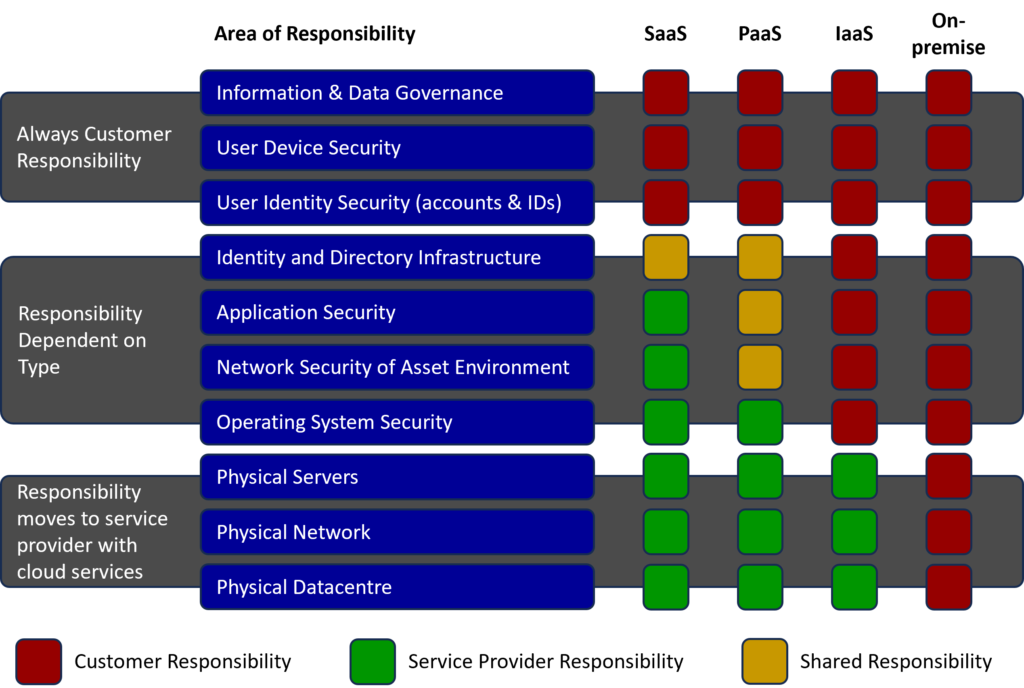
With cloud services the responsibility for security is shared between the customer and the service provider. For instance, the service provider is responsible for ensuring there is a secure method for users to log into the system, and that your data cannot be accessed by someone who has not logged in with the correct rights and permissions. But as the customer, it is your responsibility to make sure you only give access and permissions to the people who need it. It is also your responsibility to ensure your users don’t choose a simple password, or share it with anyone, and to enable MFA if that is available. The diagram below outlines where responsibility falls for the majority of cloud services.
Q5: What Connects to What?


Having gone into the issues outlined so far it would be a shame to then leave the back door open. Would you invest in a strong front door with a five lever lock and covered it with CCTV if your side door was only secured with a £5 Yale Lock. In the digital world, we are presented with a dizzying array of different applications that can make our life easier by integrating with each other. This is particularly the case with the cloud SaaS applications, where we can often connect one service to another at the click of a mouse.


You might connect your CRM to your email service so that it tracks the interactions you are having with individual customers. Or you might connect a reporting and analysis service to your financial management application. But each time you connect two services together you are opening up a new route to the asset. In the first example, your email service might be highly secure, but if the CRM service is insecure then the bad actor can get to your data that way.


Risk is a balancing act. There will always be risk, but the objective is to balance the benefit that you get against the risk that it introduces. Returning to the CRM example, you might allow members of your sales team to integrate it with email because the business benefit is significant, but not your executive team because the risk is not justified.


Another area of integration risk that is frequently overlooked is the use of browser extensions. These little apps that can be installed into the browser might block advertisements, offer a convenient dictionary or calculator, or provide a short cut for a particular website. But whenever you install an extension you are giving it certain permissions, and bad people can publish extensions as well as good people.


Conclusion


Good security is never done, and is best approached as an ongoing task. The five questions above are intended as helpful guidance rather than a comprehensive approach. But the important thing to do is to get started. Over time you can progressively improve your security and reduce your risk. In turn this can give you confidence to be bolder in the marketplace and to address opportunities that you previously felt were out of your reach.


If you want to discuss how you can improve your security, reduce your digital risk, and face the future with confidence, get in touch with Tom Burton, Senior Partner - Cyber Security, using the below form.


Contact - SME Cyber Security article

Subscribe to our Newsletter

Blog Subscribe

SHARE CONTENT

Neon letters 'Ai' made from stacks of blocks like a 3D bar graph
by Darren Sheppard 4 December 2025
What is the Contract Lifecycle Management and Why does it Matter? The future success of your business depends on realising the value that’s captured in its contracts. From vendor agreements to employee documents, everywhere you look are commitments that need to be met for your business to succeed. The type of contract and the nature of goods or services it covers will determine what sort of management activities might be needed at each stage. How your company is organised will also determine which departments or individuals are responsible for what activities at each stage. Contract Lifecycle Management, from a buyer's perspective, is the process of defining and designing the actual activities needed in each stage for any specific contract, allocating ownership of the activities to individuals or groups, and monitoring the performance of those activities as the contract progresses through its lifecycle. The ultimate aim is to minimise surprises, ensure the contracted goods or services are delivered by the vendor in accordance with the contract, and realise the expected business benefits and value for money. The Problem of Redundant Spend in Contracts Despite the built-in imbalance of information favoring suppliers, companies still choose to oversee these vendors internally. However, many adopt a reactive, unstructured approach to supplier management and struggle to bridge the gap between contractual expectations and actual performance. Currently, where governance exists, it is often understaffed, with weak, missing, or poorly enforced processes. The focus is primarily on manual data collection, validation, and basic retrospective reporting of supplier performance, rather than on proactively managing risk, relationships, and overall performance. The amount of redundant spend in contracts can vary widely depending on the industry, the complexity of the contracts, and how rigorously they are managed. For further information on this, Cambridge MC’s case studies provide insights into typical ranges and common sources of redundant spend. As a general estimate, industry analysts often state that redundant spend can account for as much as 20% of total contract value. In some cases, especially in poorly managed contracts, this can be much higher. What is AI-driven Contract Management? Artificial Intelligence (AI) is redefining contract management, transforming a historically time-consuming and manual process into a streamlined, efficient, and intelligent operation. Traditionally, managing contracts required legal teams to navigate through extensive paperwork, drafting, reviewing, and monitoring agreements — a process prone to inefficiencies and human error. With the emergence of artificial intelligence, particularly generative AI and natural language processing (NLP), this area of operations is undergoing a paradigm shift. This step change is not without concerns however, as there are the inevitable risks of AI hallucinations, training data biases and the threat to jobs. AI-driven contract management solutions not only automate repetitive tasks but also uncover valuable insights locked up in contract data, improving compliance and reducing the risks that are often lost in reams paperwork and contract clauses. Put simply, AI can automate, analyse, and optimise every aspect of your contract lifecycle. From drafting and negotiation to approval, storage, and tracking, AI-powered platforms enhance precision and speed across these processes; in some cases reducing work that might take several days to minutes or hours. By discerning patterns and identifying key terms, conditions, and concepts within agreements, AI enables businesses to parse complex contracts with ease and efficiency. In theory, this empowers your legal and contract teams (rather than reducing them), allowing personnel to focus on high-level tasks such as strategy rather than minutiae. However, it is important to recognise that none of the solutions available in the marketplace today offer companies an integrated supplier management solution, combining a comprehensive software platform, capable of advanced analytics, with a managed service. Cambridge Management Consulting is one of only a few consultancies that offers fully integrated Contract Management as a Service (CMaaS). Benefits of Integrating AI into your Contract Lifecycle Management Cambridge MC’s Contract Management as a Service (CMaaS) 360-degree Visibility: Enable your business to gain 360-degree visibility into contracts and streamline the change management process. Real-time Data: Gain real-time performance data and granularly compare it against contractually obligated outcomes. More Control: Take control of your contracts and associated relationships with an integrated, centralised platform. Advanced meta data searches provide specific information on external risk elements, and qualitative and quantitative insights into performance. Reduces Costs: By automating manual processes, businesses can significantly reduce administrative costs associated with contract management. AI-based solutions eliminate inefficiencies in the contract lifecycle while minimising reliance on external legal counsel for routine tasks. Supplier Collaboration: Proactively drive supplier collaboration and take a data-driven approach towards managing relationships and governance process health. Enhanced Compliance: AI tools ensure that contracts adhere to internal policies and external regulations by flagging non-compliant clauses during the drafting or review stage. This proactive approach reduces the risk of costly disputes or penalties. Reduces Human Errors: In traditional contract management processes, human errors can lead to missed deadlines and hidden risks. AI-powered systems use natural language processing to identify inconsistencies or inaccuracies in contracts before they escalate into larger issues. Automates Repetitive Tasks: AI-powered tools automate time-consuming tasks such as drafting contracts, reviewing documents for errors, and extracting key terms. This frees up legal teams to focus on higher-value activities like strategic negotiations and risk assessment. We can accurately model and connect commercial information across end-to-end processes and execution systems. AI capabilities then derive and apply automated commercial intelligence (from thousands of commercial experts using those systems) to error-proof complex tasks such as searching for hidden contract risks, determining SLA calculations and performing invoice matching/approvals directly against best-in-class criteria. Contract management teams using AI tools reported an annual savings rate that is 37% higher than peers. Spending and tracking rebates, delivery terms and volume discounts can ensure that all of the savings negotiated in a sourcing cycle are based on our experience of managing complex contracts for a wide variety of customers. Our Contract Management as a Service, underpinned by AI software tooling, has already delivered tangible benefits and proven success. 8 Steps to Transition Your Organisation to AI Contract Management Implementing AI-driven contract management requires a thoughtful and structured approach to ensure seamless integration and long-term success. By following these key steps your organisation can avoid delays and costly setbacks. Step 1 Digitise Contracts and Centralise in the Cloud: Begin by converting all existing contracts into a digital format and storing them in a secure, centralised, cloud-based repository. This ensures contracts are accessible, organised, and easier to manage. A cloud-based system also facilitates real-time collaboration and allows AI to extract data from various file formats, such as PDFs and OCR-scanned images, with ease. Search for and retrieve contracts using a variety of advanced search features such as full text search, Boolean, regex, fuzzy, and more. Monitor upcoming renewal and expiration events with configurable alerts, notifications, and calendar entries. Streamline contract change management with robust version control and automatically refresh updated metadata and affected obligations. Step 2 Choose the Right AI-Powered Contract Management Software: Selecting the right software is a critical step in setting up your management system. Evaluate platforms based on their ability to meet your organisation’s unique contracting needs. Consider key factors such as data privacy and security, integration with existing systems, ease of implementation, and the accuracy of AI-generated outputs. A well-chosen platform will streamline workflows while ensuring compliance and scalability. Step 3 Understand How AI Analyses Contracts: To make the most of AI, it’s essential to understand how it processes contract data. AI systems use Natural Language Processing (NLP) to interpret and extract meaning from human-readable contract terms, while Machine Learning (ML) enables the system to continuously improve its accuracy through experience. These combined technologies allow AI to identify key clauses, conditions, and obligations, as well as extract critical data like dates, parties, and legal provisions. Training your team on these capabilities will help them to understand the system and diagnose inconsistencies. Step 4 Maintain Oversight and Validate AI Outputs: While AI can automate repetitive tasks and significantly reduce manual effort, human oversight is indispensable. Implement a thorough process for spot-checking AI-generated outputs to ensure accuracy, compliance, and alignment with organisational standards. Legal teams should review contracts processed by AI to verify the integrity of agreements and minimise risks. This collaborative approach between AI and human contract management expertise ensures confidence in the system. Step 5 Refine the Data Pool for Better Results: The quality of AI’s analysis depends heavily on the data it is trained on. Regularly refine and update your data pool by incorporating industry-relevant contract examples and removing errors or inconsistencies. A well-maintained data set enhances the precision of AI outputs, enabling the system to adapt to evolving business needs and legal standards. Step 6 Establish Frameworks for Ongoing AI Management: To ensure long-term success, set clear objectives and measurable goals for your AI contract management system. Define key performance indicators (KPIs) to track progress and prioritise features that align with your organisation’s specific requirements. Establish workflows and governance frameworks to guide the use of AI tools, ensuring consistency and accountability in contract management processes. Step 7 Train and Empower Your Teams: Equip your teams with the skills and knowledge they need to use AI tools effectively. Conduct hands-on training sessions to familiarise users with the platform’s features and functionalities. Create a feedback loop to gather insights from your team, allowing for continuous improvement of the system. Avoid change resistance by using change management methodologies, as this will foster trust in the technology and drive successful adoption. Step 8 Ensure Ethical and Secure Use of AI: Tools Promote transparency and integrity in the use of AI-driven contract management. Legal teams should have the ability to filter sensitive information, secure data within private cloud environments, and trace data back to its source when needed. By prioritising data security and ethical AI practices, organisations can build trust and mitigate potential risks. With the right tools, training, and oversight, AI can become a powerful ally in achieving operational excellence as well as reducing costs and risk. Overcoming the Technical & Human Challenges While the benefits are compelling, implementing AI in contract management comes with some unique challenges which need to be managed by your leadership and contract teams: Data Security Concerns: Uploading sensitive contracts to cloud-based platforms risks data breaches and phishing attacks. Integration Complexities: Incorporating AI tools into existing systems requires careful planning to avoid disruptions and downtime. Change Fatigue & Resistance: Training employees to use new technologies can be time-intensive and costly. There is a natural resistance to change, the dynamics of which are often overlooked and ignored, even though these risks are often a major cause of project failure. Reliance on Generic Models: Off-the-shelf AI models may not fully align with your needs without detailed customisation. To address these challenges, businesses should partner with experienced providers who specialise in delivering tailored AI-driven solutions for contract lifecycle management. Case Study 1: The CRM That Nobody Used A mid-sized company invests £50,000 in a cutting-edge Customer Relationship Management (CRM) system, hoping to streamline customer interactions, automate follow-ups, and boost sales performance. The leadership expects this software to increase efficiency and revenue. However, after six months: Sales teams continue using spreadsheets because they find the CRM complicated. Managers struggle to generate reports because the system wasn’t set up properly. Customer data is inconsistent, leading to missed opportunities. The Result: The software becomes an expensive shelf-ware — a wasted investment that adds no value because the employees never fully adopted it. Case Study 2: Using Contract Management Experts to Set Up, Customise and Provide Training If the previous company had invested in professional services alongside the software, the outcome would have been very different. A team of CMaaS experts would: Train employees to ensure adoption and confidence in using the system. Customise the software to fit business needs, eliminating frustrations. Provide ongoing support, so issues don’t lead to abandonment. Generate workflows and governance for upward communication and visibility of adherence. The Result: A fully customised CRM that significantly improves the Contract Management lifecycle, leading to: more efficient workflows, more time for the contract team to spend on higher value work, automated tasks and event notifications, and real-time analytics. With full utilisation and efficiency, the software delivers real ROI, making it a strategic investment instead of a sunk cost. Summary AI is reshaping the way organisations approach contract lifecycle management by automating processes, enhancing compliance, reducing risks, and improving visibility into contractual obligations. From data extraction to risk analysis, AI-powered tools are empowering legal teams with actionable insights while driving operational efficiency. However, successful implementation requires overcoming challenges such as data security concerns and integration complexities. By choosing the right solutions, tailored to their needs — and partnering with experts like Cambridge Management Consulting — businesses can overcome the challenges and unlock the full potential of AI-based contract management. A Summary of Key Benefits Manage the entire lifecycle of supplier management on a single integrated platform Stop value leakage: as much as 20% of Annual Contract Value (ACV) Reduce on-going governance and application support and maintenance expenses by up to 60% Deliver a higher level of service to your end-user community. Speed without compromise: accomplish more in less time with automation capabilities Smarter contracts allow you to leverage analytics while you negotiate Manage and reduce risk at every step of the contract lifecycle Up to 90% reduction in creating first drafts Reduction in CLM costs and extraction costs How we Can Help Cambridge Management Consulting stands at the forefront of delivering innovative AI-powered solutions for contract lifecycle management. With specialised teams in both AI and Contract Management, we are well-placed to design and manage your transition with minimal disruption to operations. We have already worked with many public and private organisations, during due diligence, deal negotiation, TSAs, and exit phases; rescuing millions in contract management issues. Use the contact form below to send your queries to Darren Sheppard , Senior Partner for Contract Management. Go to our Contract Management Service Page
Sun through the trees
by Scott Armstrong 26 November 2025
Nature means something different to everyone. For some, it is a dog-walk through the park; for others, it is hiking misty mountains in Scotland, swimming in turquoise waters, or exploring tropical forests in Costa Rica.
Aerial view of Westminster, London.
by Craig Cheney 25 November 2025
With the UK Budget being published tomorrow, councils are facing intense financial pressure. Rising demand for adult and children’s social care, homelessness services, and temporary accommodation has left little room for manoeuvre.
by Cambridge Management Consulting 20 November 2025
Press Release
Lightning strike in dark sky
by Scott Armstrong 17 November 2025
Non-commodity charges are driving UK energy costs higher. Discover what’s changing, why it matters, and the steps businesses should take to protect budgets | READ NOW
Futuristic building with greenery growing out of it.
by Cambridge Management Consulting 10 November 2025
Over the last few decades, carbon offsetting has become a go-to strategy for businesses looking to demonstrate sustainability commitments and enhance their external credibility. Offsetting takes many forms, from tree planting and forest conservation to providing communities with clean cookstoves and renewable energy.
Aerial view of solar panels in a green field.
by Drew Davy 7 November 2025
In today's rapidly evolving business landscape, Environmental, Social, and Governance (ESG) factors have moved from niche considerations to critical drivers of long-term value, investor confidence, and societal impact.
Two blocks of data with bottleneck inbetween
by Paul Brooker 29 October 2025
Read our article on hidden complexity and find out how shadow IT, duplicate tools and siloed buying bloat costs. See how CIOs gain a single view of IT spend to cut waste, boost compliance and unlock 5–7% annual savings | READ FULL ARTICLE
More posts