Case Study: Supporting Thames Freeport to Create an Innovation Strategy to Drive Inward Investment

Matt Lawson

Emerging as a hub for innovation, Thames Freeport is a unique initiative designed to stimulate trade and transform the lives of people in its region. Leveraging global connectivity and occupying a strategic position with intermodal capabilities across river, rail, and road, Thames Freeport has recognised its opportunity to drive economic regeneration for the local area.


Thames Freeport engaged Cambridge Management Consulting to design a clear strategy for innovation over the next three to five years. Key considerations for this innovation strategy included objectives and KPIs, the future of the business ecosystem in the region, physical clusters and assets such as innovation hubs, and opportunities and challenges on the way.


The Solution


Working with our innovation partner, L Marks, Cambridge MC conducted an innovation strategy

project which involved the following:


  • Engaging with a range of stakeholders and partners from local authorities to corporate partners across the Thames Freeport area, leveraging interviews with key individuals to build a common picture of innovation aspirations, opportunities, and challenges.


  • Conducting a series of workshops for the Thames Freeport team to consider visions and objectives, themes and focus areas, physical hubs and overall programme structure, and a three-year roadmap plan.


  • Building a comprehensive innovation strategy which internalised all of the above questions. This was then presented to their board and formed the basis of the public tenders for innovation programmes that were then made public.
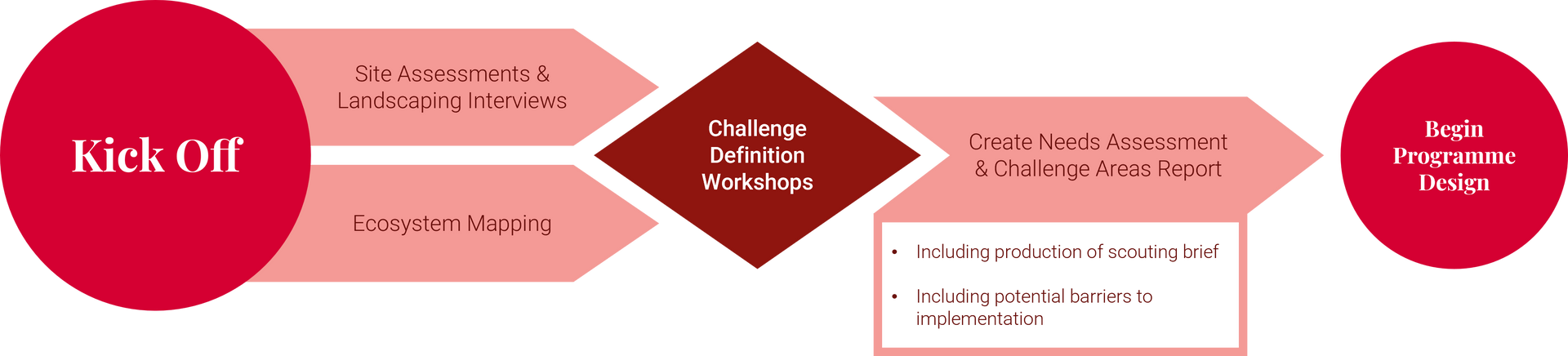
Having completed the innovation strategy project, Cambridge MC and L Marks subsequently designed the 5G Innovation Programme (one of the first to be prioritised in our work). This involved the following:


  • Engaging with three commercial sites (Ford, Tilbury Port, London Gateway – DP World) to understand the potential pain-points and opportunities for private 5G network innovation.


  • Conducting category-identified workshops to pull out specific themes and challenges that would form the basis of a scouting brief to identify potential companies globally to participate in the programme.


  • Designing a challenge-based open innovation programme to attract companies globally to address the challenges and opportunities, and collaborate with the Thames Freeport partners on solutions.


  • Conducting a global research exercise to identify example case studies and use cases for 5G private networks in the logistics and manufacturing sectors.
Outcomes & Results


  1. Roadmap to Success: We clearly articulated a five-year innovation vision and ecosystem map with broad stakeholder buy-in. This included a three-year innovation programme design covering specific projects and interventions to deliver the strategy and objectives.
  2. Transparent Progress & Goals: We provided clear objectives for innovation with associated KPIs, including a target to create five new £1Bn+ investments, engaging with 350 global hightech companies, implementing 50 new innovative solutions, and building four operational innovation hubs.
  3. Regional Improvement: Our programme demonstrated how innovation can create multiple highly-skilled jobs in the area, and improve quality of life for local residents.
  4. Long-Term Benefit: We clearly defined the themes and focus areas for innovation that the Thames Freeport should prioritise, aligned with regional strengths and capabilities.
DOWNLOAD CASE STUDY

Get in touch with Our Consultants today


Contact - LightRiver Case Study

Subscribe to our Newsletter

Blog Subscribe

SHARE CONTENT

by Mauro Mortali 9 May 2026
We were approached by a global networking systems, services, and software company that specialises in optical and routing solutions. Their technology helps carriers, enterprises, and governments build more efficient and scalable networks, particularly for high-bandwidth applications like 5G, cloud computing, and AI-driven networking. Africa is a key strategic market for this client. They are also playing an active role in advancing outlined 5G technology on the continent, emphasising a focus on routing and switching aggregation components, network slicing, and monetisation. The Opportunity The client engaged Cambridge MC to provide external insight and support to augment and accelerate the progress of their Go-to-Market plans for Africa. We proposed our in-house rapid Strategy Stress Test that delivers key insights across areas of your strategy using a 1–5 health-scoring matrix. The client's aim is to grow market share in the region with a precisely focussed strategy that targets their market with key propositions and solutions. We were engaged to review this strategy and their plans for the region, identifying critical opportunities and gaps with a quick turnaround. Approach We used our Rapid Strategy Stress Test methodology which provides: Target geographies, opportunities, and partners for resource effectiveness and success maximisation Assessment of client's Go-to-Market Strategy including identification and testing of key assumptions Identification of new opportunities and any gaps in the strategy Recommendations on how best to capitalise on the market and accelerate their route to success This included carrying out target addressable and client-addressable market sizing by country for the Optical, Data Centre Interconnect, Routing and Switching portfolios; competitor market share analysis; analysis of current and planned data centre build in the target countries; future trend analysis, including Political, Economic, Social, Technological, Legal and Environmental trends by country. We put their GtM strategy and plans through our Stress Test framework, scoring capabilities against best-in-class – across 11 parameters such as Market Potential, Adaptability to Local Needs, Pricing and Marketing & Demand Generation. Recommendations were made against each of the 11 areas relating to opportunities to accelerate their GtM strategy. In order to support effective targeting of resources into key countries, we developed a country prioritisation framework across 15 parameters, such as GDP growth, energy supply, stability of regulatory environment, and ease of doing business. This quantitative assessment was supplemented with the real world experience of our Africa experts. 
A digital human made of blocks and wires jumping into the air
by Ruth Redding 23 April 2026
Why digital transformation fails: human adoption. Learn how leaders can reduce change resistance, protect ROI and improve programme success with structured change management | READ FULL ARTICLE
Businessman walks across desert into AI portal
9 April 2026
This article suggests how to pilot AI in 90 days with five practical use cases for operations leaders – from triage and forecasting to summarisation – with clear governance and measurable value | READ FULL ARTICLE
Wind farms  and solar panels in the countryside at dawn
by Scott Armstrong 27 March 2026
Sustainability | Energy, risk and competitiveness – find out why sustainability is no longer just about reporting, but about resilience, cost control and long-term advantage | READ FULL ARTICLE
Yello and turquoise neon lights.
24 March 2026
International consulting firm, Cambridge Management Consulting has acquired telecommunications cost-reduction specialist, The Carrier Club, strengthening its ability to help organisations reduce their telecoms and network infrastructure costs.
Pembroke College lawn bathed in sunlight
by Tim Passingham 12 March 2026
CAMBRIDGE | See how Cambridge MC and Pembroke College are creating mutual value through a unique corporate partnership spanning student opportunities, academic collaboration and industry events | READ FULL CASE STUDY
Neon sharks made out of code.
by Simon Crimp 9 March 2026
Cyber Security | Ransomware in 2026 is a board-level resilience issue. Learn the key risks, weak spots and practical questions boards should ask to improve readiness, recovery and response.
The Top 21.2026 at the awards event in Cambridge, UK.
6 March 2026
The #21toWatch Top21.2026 winners have been announced at an awards ceremony at The Glasshouse innovation hub in Cambridge.
Asian business woman near a long window and looking at a tablet.
by Arianna Mortali 6 March 2026
BLOG | A student’s perspective on why women shouldn’t have to ‘play masculine’ to succeed at work – and how valuing empathy, confidence and inclusive leadership can help close gender gaps and build healthier organisations.
More posts