
The Modern Data Centre: Power, Progress, and Paradox
KEY TAKEAWAYS
- Data centres are 'invisible' infrastructure – unremarkable buildings packed with servers, power backup and cooling that keep the digital world running 24/7.
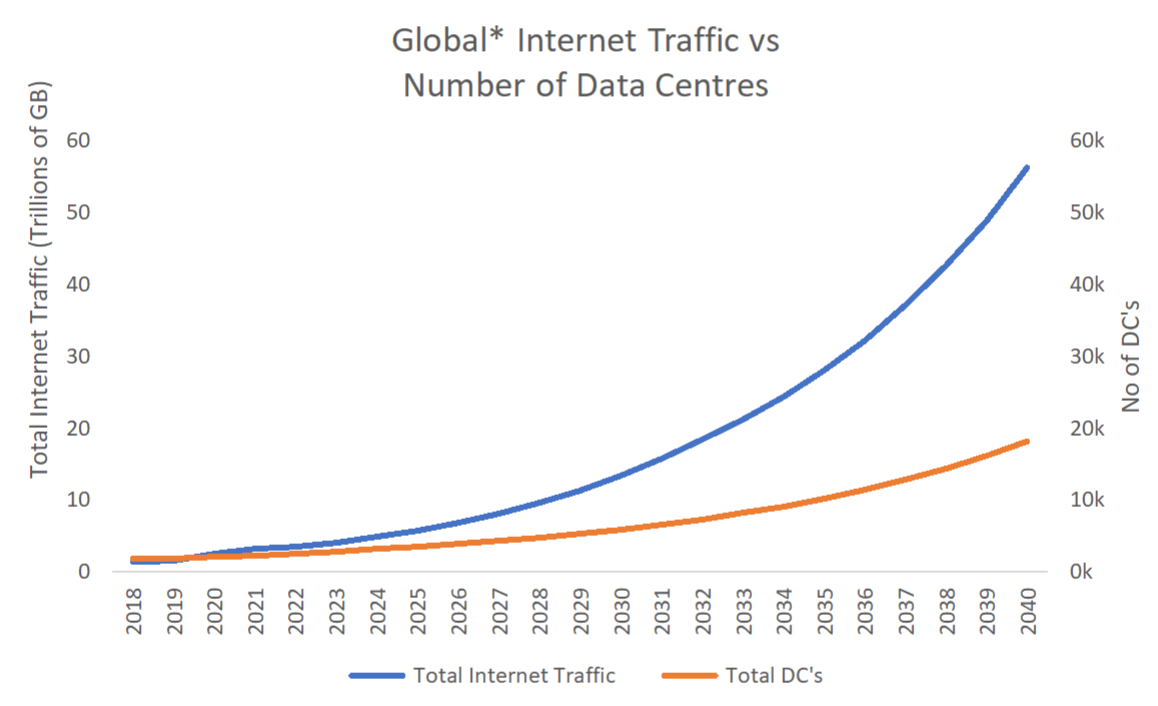
- Even with major efficiency gains, total electricity use is rising fast as AI and cloud demand accelerates – a classic Jevons’ Paradox problem.
- Rack densities are surging (AI racks can reach 120+ kW), pushing power, heat and grid constraints to the forefront of data-centre strategy.
- The industry is shifting from air to liquid cooling and exploring waste-heat reuse to manage high-density loads and improve sustainability outcomes.
4 MIN READ
Introduction
Duncan Clubb, Senior Partner – Data Centres, Edge & Cloud, was recently invited onto Commercis' Impactful Innovation podcast where he was asked to demystify the role of data centres in our digital society.
You can watch the full interview here: https://www.youtube.com/watch?v=8ACXIjFyoQo
Duncan starts by pointing out that these infrastructure giants are often hidden in generic-looking warehouses in our physical landscape – most of us have driven past a data centre at some point without ever recognising what it was.
“Fundamentally, they’re just facilities designed to house computers” he says[1]. In reality, these unmarked buildings quietly keep computers running and data flowing 24/7. Behind every click, video stream or cloud backup lies rows of servers, storage arrays and networking gear, all backed by layers of batteries, generators and advanced cooling systems to ensure near‑constant uptime[1][2].
While early data centres might have been just a dusty closet full of cables, they have grown into hyperscale campuses operated by tech giants, with Amazon, Google and Microsoft at the forefront of a $250bn industry.
The Energy Paradox of Efficiency
Today’s data centres have become voracious energy consumers. Industry analysts estimate they already use roughly 1–2% of global electricity – a figure set to rise as AI and cloud demand grow[5]. Indeed, Goldman Sachs forecasts that share will climb to around 3–4% by 2030[5]. (For context, the International Energy Agency projects global data center power use will more than double to about 945 TWh by 2030 – slightly more than the total consumption of Japan today[6]).
This raises a profound irony: data centres have made staggering efficiency gains in power and cooling, yet total energy use keeps climbing. Duncan calls this an example of Jevons’ Paradox – improvements in efficiency actually fuel greater demand. As he illustrates, “you add an extra lane to a motorway, the motorway doesn’t become less busy, it becomes more busy,” – meaning that each leap in hardware or cooling efficiency tends to unlock even more computing capacity and more power draw[7].
The result is that data centres now quietly consume more power than entire sectors like aviation or steelmaking. In Duncan’s view, this energy paradox is perhaps the defining challenge of modern computing: efficiency alone can’t contain our appetite for digital services and AI.
"
You add an extra lane to a motorway, the motorway doesn’t become less busy, it becomes more busy."
— Duncan Clubb
Scaling Up: Rack Densities and Infrastructure
To meet that demand, data centres keep scaling up. Server racks that once drew just a few kilowatts now routinely consume dozens. Where racks once consumed around 2 kW each, today’s high‑performance racks – especially for AI – reach upwards of 120 kW per rack.
Industry surveys confirm this trend: the average rack density today is about 12 kW (double what it was a decade ago) and some facilities plan for 30+ kW racks[11]. In practical terms, a standard 42‑U cabinet is now packed with dozens of powerful servers, each fitted with multi‑core CPUs and GPUs. These advanced chips deliver jaw-dropping performance but also generate enormous heat.
Artificial intelligence looms large in this story. By one estimate, AI will account for about 19% of data center power by 2028[15]. In concrete terms, that could push data centre load in the US alone from about 3% of the grid in 2022 to as much as 8% by 2030[16].
From Air to Liquid Cooling
Cooling these high-density racks has long been the Achilles’ heel of data centers. Traditionally, for every kilowatt of computing power a server used, nearly another kilowatt might go into fans and chillers. In early days that 2:1 ratio made climate control one of the largest operational costs (and carbon costs) after the servers themselves.
Over time, engineers have dramatically improved airflow, hot/cold aisle containment, and chiller efficiency. Today’s state-of-the-art data halls can achieve PUEs well below 1.2 in optimal climates. However, as racks get denser with AI chips, even these advances can struggle to keep temperatures in check.
As Duncan explains, one of the major breakthroughs has been liquid cooling. By delivering coolant directly to the hottest components, liquid systems move heat far more efficiently than air. He notes, “[liquid cooling] is beginning to come into its own now. The next generation of Nvidia chips, a lot of those will be liquid-cooled”.
The latest GPUs and CPUs are often built with liquid cooling in mind. In fact, data centre designers estimate water’s heat capacity is roughly 3,000 times that of air, meaning liquid can whisk away heat orders of magnitude faster[19].
The liquid trend is accelerating: industry analysts predict only about 22% of current data centers use any form of liquid cooling, but that could rise to nearly 50% within five years[22]. In-rack and direct-to-chip cooling solutions are being deployed from webscale clouds to colocation facilities. Even liquid immersion (submerging servers in dielectric fluid) is gaining traction for ultra-dense clusters.

Turning Waste into Warmth
Another innovation involves reusing waste heat. Instead of disposing of this energy, visionary operators are turning it into a community resource. In Scandinavia, for example, data centres already feed hot-water networks and district heating systems.
As Duncan observes, “waste heat reclamation in the Nordics, where it started, is being used to provide free hot water for municipalities”. One Finnish data centre project in Mäntsälä reuses roughly 20,000 MWh per year of waste heat – enough to supply the heating needs of about 2,500 homes[24]. In Sweden’s Stockholm Data Parks initiative, multiple centres pipe residual heat into the city grid. Even outside Europe, Amazon and Microsoft are launching schemes to recycle heat: new plants in London and Finland are slated to heat thousands of homes via district networks[25].
Duncan is encouraged by these examples, noting that they underscore a shift in perspective towards sustainability. Rather than fight the byproduct of power, data centres are seeing it as a resource. This approach – along with renewable power purchases and carbon offsets – help to mitigate the energy paradox of more efficiency leads to more demand.
Conclusion
The big challenge ahead, Duncan says, is to balance growth with sustainability. We’ve come a long way – servers are 30x more efficient than 20 years ago – but we’re still in a race against our own appetite for data and media.
By combining smarter cooling, reuse of waste energy, and new efficiency tricks, the industry strives to meet demand without shorting out the planet.
Watch the full podcast here: https://www.youtube.com/watch?v=8ACXIjFyoQo
Find out More about Our Services
Our data centre solutions connect cloud and data centre colocation with hybrid strategies, ensuring smoother transformations and costs benefits for clients. We support strategy, design, and construction for investors, enterprise, operators and business.
Find out more on our Data Centres, Edge & Cloud service page: https://www.cambridgemc.com/digital-infrastructure/data-centres-edge-cloud
Select Sources:
[26][3][6][5][24] [20][22] Duncan Club’s interview on Impactful Innovation: https://www.youtube.com/watch?v=8ACXIjFyoQo
[5] [13] [14] [15] [16] AI is poised to drive 160% increase in data center power demand | Goldman Sachs
https://www.goldmansachs.com/insights/articles/AI-poised-to-drive-160-increase-in-power-demand
[6] Energy and AI
https://iea.blob.core.windows.net/assets/601eaec9-ba91-4623-819b-4ded331ec9e8/EnergyandAI.pdf
[9] [24] [25] These companies are using data centres to heat cities | World Economic Forum
https://www.weforum.org/stories/2025/06/sustainable-data-centre-heating/
[11] Exploring Data Center Rack Density | Average kW Per Rack
https://blog.enconnex.com/data-center-rack-density
[19] [22] The Future is Liquid: How In-Rack and Direct-to-Chip Cooling are Revolutionizing Data Centers

Duncan Clubb
Senior Partner – Data Centres, Edge & Cloud

About Us
Cambridge Management Consulting (Cambridge MC) is an international consulting firm that helps companies of all sizes have a better impact on the world. Founded in Cambridge, UK, initially to help the start-up community, Cambridge MC has grown to over 200 consultants working on projects in 25 countries. Our capabilities focus on supporting the private and public sector with their people, process and digital technology challenges.
What makes Cambridge Management Consulting unique is that it doesn’t employ consultants – only senior executives with real industry or government experience and the skills to advise their clients from a place of true credibility. Our team strives to have a highly positive impact on all the organisations they serve. We are confident there is no business or enterprise that we cannot help transform for the better.
Cambridge Management Consulting has offices or legal entities in Cambridge, London, New York, Paris, Dubai, Singapore and Helsinki, with further expansion planned in future.
Contact Form
Subscribe to our Newsletter
Blog Subscribe
SHARE CONTENT