

The Complexity Tax

KEY TAKEAWAYS
- Fragmented systems and manual workarounds impose a hidden 'Complexity Tax' that drives up OPEX, delays revenue, and erodes margin across telecommunications operators.
- Skilled employees have become the de facto integration layer between disconnected systems, reconciling data and correcting errors instead of creating value.
- Automating a broken process without redesigning it only allows mistakes to happen faster.
- Connecting and orchestrating existing systems around a single high-value process, rather than replacing them outright, delivers measurable results, as shown by Telstra's reported 20% OPEX reduction and 30% faster time-to-market.
4 MIN READ
Introduction
The telecommunication industry has continued to invest heavily into digitisation, OSS/BSS modernisation, automation, and, increasingly, Artificial Intelligence (Al).
Yet, across many operators, some of the most commercially important processes, such as invoicing, remain fragmented, manual, and dependent on people bridging the gap between systems.
The question, 'Why does the invoice amount not reflect the order amount?', might seem like a simple one, albeit an important one, but it often leads to a more complex inquiry: how much time, cost, and investigation does it take to find out why, and then to rectify it?
Between emails, meetings, and spreadsheets shared from the Sales team to Service Delivery and Finance, the problem is ultimately resolved, but all with the time and expense associated with a manual solution.
This reduces the experts in the telecommunications industry to middleware: reconciling data, moving information between systems, interpreting requirements, correcting orders, validating inventory, and compensating for processes that do not work end-to-end.
This is the ‘Complexity Tax’, and can be identified from common symptoms:
- Higher OPEX
- Slower customer response
- Costly rework
- Delayed revenue
- Revenue leakage
- Longer order-to-activation cycles
- Employees spending their time administering complexity rather than creating value
TM Forum identifies manual complex enterprise quoting as a source of slow responses, lost opportunities, configuration problems, costly rework, and revenue leakage.
Similarly, Mckinsey reports that network complexity continues to increase while telecom operators face long-term structural pressure on network economics; its analysis suggests Al-driven operational use cases could contribute to reductions of 15–30% in total network OPEX where the technology is combined with genuine process and operating-model redesign.
Demonstrating this, TM Forum also cites Telstra achieving a 20% OPEX reduction and 30% faster time-to-market in a 5G networkslicing example.
The opportunity, therefore, is considerably larger than just introducing more automation. It is about removing complexity from the path between customer intent and revenue, and ergo reducing the cost of complexity.
Automation over Simplification
Telecommunication is one of the world’s most technologically sophisticated industries. It is also one of the most operationally complex. Decades of network evolution, product expansion, acquisitions, regulatory change, and technology transformation have created environments that contain some combination of:
- Multiple OSS and BSS platforms
- Legacy applications
- Overlapping product catalogues
- Fragmented network inventories
- Multiple CRM and commercial systems
- Bespoke integrations
- Inconsistent service models
- Disconnected datasets
- Spreadsheets and manual processes
- Substantial amounts of specialist institutional knowledge
While individual systems may function effectively, problems may arise when they need to work together. As such, the issue is not necessarily the technology, but the way the technology is interconnected, and the data, processes, and organisations that use them. This complexity comes with a cost.
Complex Enterprise Quoting: Why the Biggest Deals Cost the Most to Win
The problem frequently occurs before an order is even made; a complex enterprise opportunity can contain many requirements, all of which have to pass through a chain of hands. These requirements exist across:
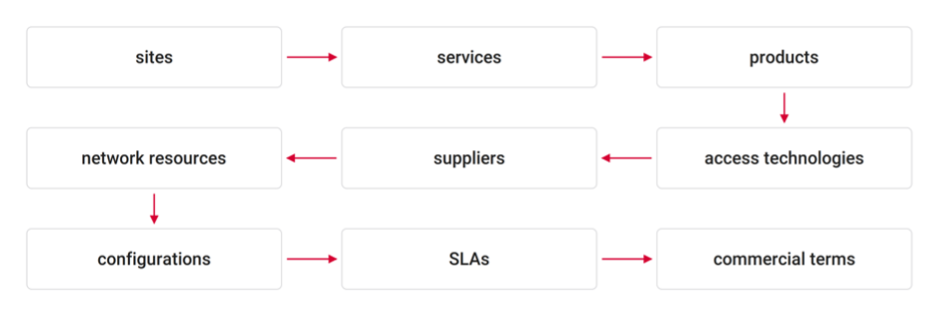
TM Forum’s work on complex B2B telecom quoting identifies a continuing dependence on manual processes, which can decelerate and complicate this process due to slow responses, lost opportunities, configurations that cannot be properly validated, manual rework, and revenue leakage. The result is an uncomfortable commercial reality: that the larger and more valuable the enterprise opportunity becomes, the more difficult, expensive, and time-consuming it can be to sell.
The impact of this is not purely administrative. Slow quotation affects competitive win rates, incorrect configuration affects margin, manual rework increases the cost of sale, and poor handoffs create fulfilment problems. Errors created during quoting travel downstream into ordering, provisioning, and eventually billing, at which point a commercial inefficiency has become an operational one, and, ultimately, a financial one.
Follow the Order, Then Follow the Money
When an invoice amount does not immediately reflect the order amount, the plausible explanations are numerous. For example, the product configuration may have changed, an agreed charge may not have transferred correctly, or a discount may have been interpreted differently. However, all of this only accounts for the visible cost.
What comes next is the hidden cost, formed of the manual efforts to retrace the discrepancy and resolve it. But what has actually been fixed in this instance? If the underlying process has been corrected, then this hidden cost has been worthwhile. However, if an employee has simply corrected this one transaction, the root cause remains and the organisation will pay the complexity tax again. Across thousands or millions of products, services, assets, orders, and invoices, isolated discrepancies become an operating problem.
Your People Are Your Most Expensive Automation Tool
This exposes one of the least discussed characteristics of complex telecom environments: members of staff are often the most expensive automation tool an operator owns.
- When systems do not communicate, people transfer information
- When data does not reconcile, people reconcile it
- When inventory cannot be trusted, people validate it
- When an order fails, people investigate it
- When a customer asks for an update, people search multiple systems
- When billing does not match the order, people work backwards through the process
- When a workflow breaks, experienced employees know the workaround
People have effectively become the integration layer between systems. Operators invest heavily in sophisticated technology, yet some of their most experienced and expensive employees spend substantial time compensating for the weaknesses between those technology platforms. Those employees are not the problem; their knowledge and commitment are frequently the reason the operating model continues to function at all. But they should be creating value, not compensating for complexity.
The CFO’s Challenge: Complexity Has a P&L
The complexity tax eventually reaches the financial statements, and hits them in several ways:
- Every unnecessary intervention creates cost
- Every delayed quotation increases pursuit cost
- Every incorrect configuration generates rework
- Every order correction consumes margin
- Every delayed activation postpones revenue
- Every service delivered but not billed correctly creates leakage
- Every unnecessary truck roll or engineering intervention adds OPEX
And every transformation programme that introduces another technology layer without addressing the underlying process can increase complexity rather than reduce it. McKinsey describes telecom network economics as facing long-term structural pressure while network complexity continues to rise. Its research suggests AI-enabled network operations could contribute to:
- A 15-30% reduction in total network OPEX
- 10-20% lower greenfield rollout CAPEX
- 15-35% lower network upgrade CAPEX
These figures should not be read as guaranteed savings from deploying AI. They point to something more strategically important: substantial economic value is trapped inside operational complexity. The CFO’s opportunity therefore extends beyond cost reduction to margin protection, reduced revenue leakage, faster time-to-revenue, working capital improvement, better capital allocation, lower cost-to-serve, and higher operational leverage. The financial question becomes how much operating cost is being spent on managing complexity.
The COO’s Challenge: Paying for Work that Should Not Exist
For the COO, complexity shows up across thousands of small operational activities. People investigate, reconcile, validate, escalate, coordinate, and correct. Individually, the tasks look insignificant. Collectively, they can consume substantial operational capacity. Consider measuring the hours spent:
- Reconciling systems
- Validating orders
- Correcting configuration errors
- Investigating billing discrepancies
- Locating information
- Manually transferring data
- Managing avoidable exceptions
- Correcting previously completed work
- Maintaining legacy workaround
Most operators know their headcount, but not necessarily how much of that headcount is consumed compensating for complexity. That question reframes the objective of operational transformation. The purpose of automation is to release scarce human capability for the work where judgement, customer understanding, engineering expertise, and creativity actually create value.
The CIO’s Challenge: Automating a Broken Process Only Makes It Faster
The telecom industry is understandably enthusiastic about AI, but AI does not compensate for poor underlying architecture. Automating a fragmented process does not necessarily simplify it. Connecting an AI agent to inconsistent datasets does not make those datasets accurate, adding another technology platform does not automatically eliminate legacy complexity, and automating a broken workflow can simply allow the organisation to make mistakes faster.
McKinsey’s research makes an important distinction: significant benefit requires operators to redesign processes, workflows, roles, and governance rather than simply layering AI onto existing operations. Without trusted data, interoperability, and consistent service models, AI risks becoming another silo.
Making What Was Sold, Delivered, and Invoiced Agree
A different model is emerging. The objective is not simply to automate individual tasks; it is to create an increasingly connected digital thread across the lifecycle:
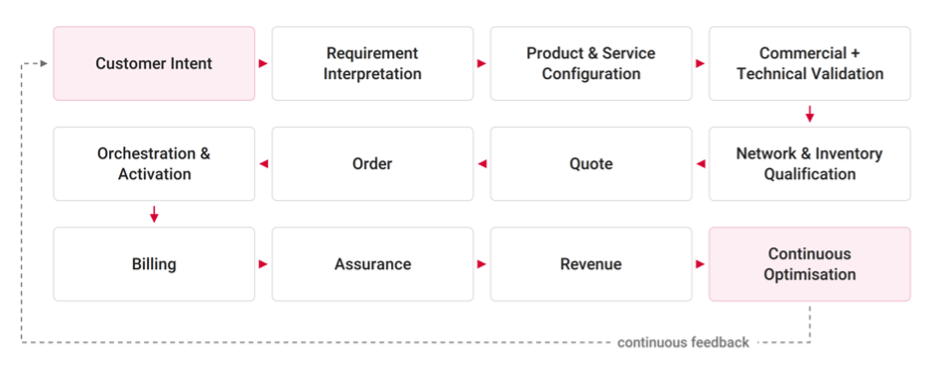
At each stage, information should become progressively richer rather than repeatedly recreated. Commercial intent should survive the transition into technical design, technical design should survive the transition into fulfilment, fulfilment should inform billing accurately, and billing should reflect the commercial agreement.
The ambition is therefore deceptively simple: what was sold, what was ordered, what was delivered, and what was invoiced should agree. Where they do not, intelligent processes should surface the exception before the customer or finance team discovers it.
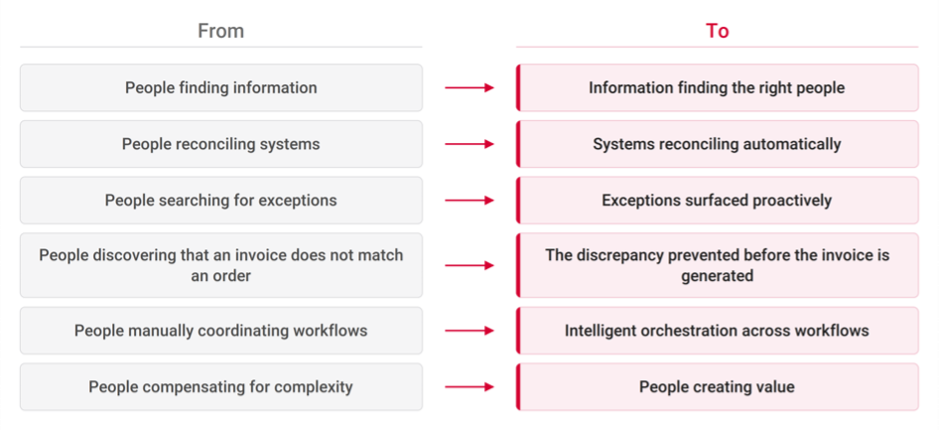
From People Finding Problems to Problems Finding People
This represents an important shift in operating philosophy, and it can be summarised as a series of moves:
The Telstra Evidence: What the Numbers Actually Show
TM Forum reports that Telstra achieved a 20% OPEX reduction and 30% faster time-to-market in a cited 5G network-slicing example. A separate TM Forum case study describes Telstra’s development of a network-service automation approach using a Knowledge Plane, intended to capture the relationships and dependencies that historically relied upon specialist engineering knowledge. TM
Forum reports that the initiative:
- Reduced processing time by 30%
- Increased order-processing capacity
- Improved NPS
- Reduced service creation and onboarding from 12-18 months to three months
AI Is an Accelerator, Not the Starting Point
The industry conversation is increasingly dominated by AI, but successful transformation should begin with the business outcome. A practical maturity path runs as follows:
- Digitise: Remove unnecessary paper, spreadsheets, and unstructured information.
- Connect: Bring together the systems and data required to execute the process.
- Understand: Create consistent representations of customers, products, services, resources, and dependencies.
- Automate: Remove repetitive activities and manual handoffs.
- Orchestrate: Coordinate decisions and actions across commercial, operational, and network domains.
- Optimise: Use AI and increasingly autonomous decision-making to improve outcomes continually.
Trying to begin at stage six while ignoring the five that precede it is one reason AI programmes can struggle to move beyond pilots.
The Complexity Tax: Twelve Questions for Your Leadership
The opportunities at hand can be exposed through a relatively simple exercise. Ask your leadership team the following questions.
THE COST
- How frequently does the invoice not match the underlying order?
- How much revenue is potentially being lost as a result?
- How much does it cost us to determine why?
THE EFFORT - How many employees touch the process?
- How much of their time is spent finding, validating, transferring, or reconciling information?
- How frequently is work repeated because information is incorrect or incomplete?
THE FRAGMENTATION - How many systems must be accessed to establish a single version of the truth?
- How accurately does inventory represent what is actually deployed?
- How much customer effort is created by our internal complexity?
THE RISK - Which critical processes depend upon knowledge held by a small number of experienced people?
- Are we automating genuinely redesigned processes, or simply adding AI to existing complexity?
- If we removed that complexity, what would it be worth?
You Do Not Need Another Multi-Year Replacement Programme
Solving this problem does not necessarily require another multi-year OSS/BSS replacement programme. A more pragmatic approach is to identify where complexity is destroying the greatest value, and to work outwards from there.
- Find the problem: Identify a process with measurable financial or operational consequences.
- Establish the baseline: Quantify time, cost, manual interventions, errors, leakage, and customer impact.
- Connect the necessary data: Create sufficient visibility across the relevant systems and processes.
- Automate intelligently: Remove repetitive intervention and unnecessary handoffs.
- Measure the outcome: Demonstrate financial and operational value.
- Scale: Extend the capability into adjacent processes.
This changes the transformation model from:
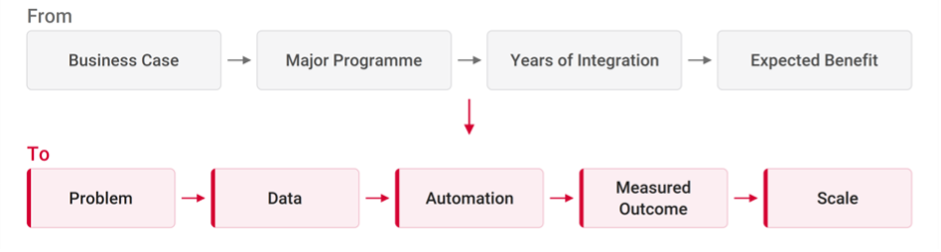
This shift in focus reduces transformation risk and allows executive confidence to be built through evidence.
The Codaxy Perspective: Connect What Exists Rather Than Replace It
Codaxy, a software development company specialising in web-based business solutions, has an approach which starts with a straightforward principle: do not solve complexity by adding another layer of complexity. The objective is to establish the connective intelligence that enables existing commercial, operational, OSS/BSS, and network environments to work together more effectively. Rather than assuming wholesale replacement of the technology estate, the opportunity is to connect and orchestrate the information and processes that already exist, progressively linking:
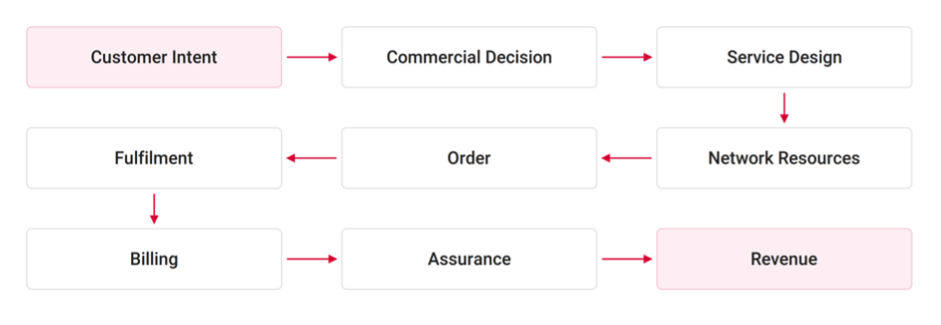
The purpose is to create the visibility required to answer fundamental questions quickly:
- Can we deliver what we are quoting?
- Does the order reflect what was sold?
- Does the network reflect what was ordered?
- Does the invoice reflect what was delivered?
- Are we billing for everything we provide?
- Where are our people compensating for gaps between systems?
- What is that complexity costing us?
These are not primarily technology questions, they are business performance questions.
Automation Is Not a Headcount Conversation
For years, automation has been associated with reducing headcount. That framing is too narrow. The more powerful opportunity is removing unnecessary work, because your people are already your most expensive automation tool. If skilled employees are routinely transferring information, reconciling data, validating configurations, correcting orders, and investigating billing discrepancies, the organisation has already automated the process – it has simply done so using humans.
The real opportunity here is to remove the unnecessary work consuming your workforce’s capacity, releasing them to focus on customers, innovation, engineering, commercial decision-making, and growth.
Conclusion: the Winners Will Not Be Those with the Most AI
Telecom networks will continue to become more sophisticated. Customer expectations will continue to increase. Margin pressure is unlikely to disappear, and AI will become increasingly pervasive.
The operators that succeed will not necessarily be those deploying the greatest number of AI tools. They will be those that first establish the data, process, and orchestration foundations that allow automation and AI to operate across the enterprise. An operator that can respond to a complex customer requirement faster has a sales advantage. One that can translate an order into service without repeated human intervention has an operational advantage. One that can ensure invoices accurately reflect contracted and delivered services has a financial advantage, and one that releases skilled employees from repetitive reconciliation has a productivity advantage. An operator capable of connecting commercial intent directly with network execution has a potentially significant competitive advantage.
About the Author

About Us
Cambridge Management Consulting (Cambridge MC) is an international consulting firm that helps companies of all sizes have a better impact on the world. Founded in Cambridge, UK, initially to help the start-up community, Cambridge MC has grown to over 200 consultants working on projects in 25 countries. Our capabilities focus on supporting the private and public sector with their people, process and digital technology challenges.
What makes Cambridge Management Consulting unique is that it doesn’t employ consultants – only senior executives with real industry or government experience and the skills to advise their clients from a place of true credibility. Our team strives to have a highly positive impact on all the organisations they serve. We are confident there is no business or enterprise that we cannot help transform for the better.
Cambridge Management Consulting has offices or legal entities in Cambridge, London, New York, Paris, Dubai, Singapore and Helsinki, with further expansion planned in future.
Contact Form
Subscribe to our Newsletter
Blog Subscribe
SHARE CONTENT