

What Drives Your Organisation’s Cyber Security?

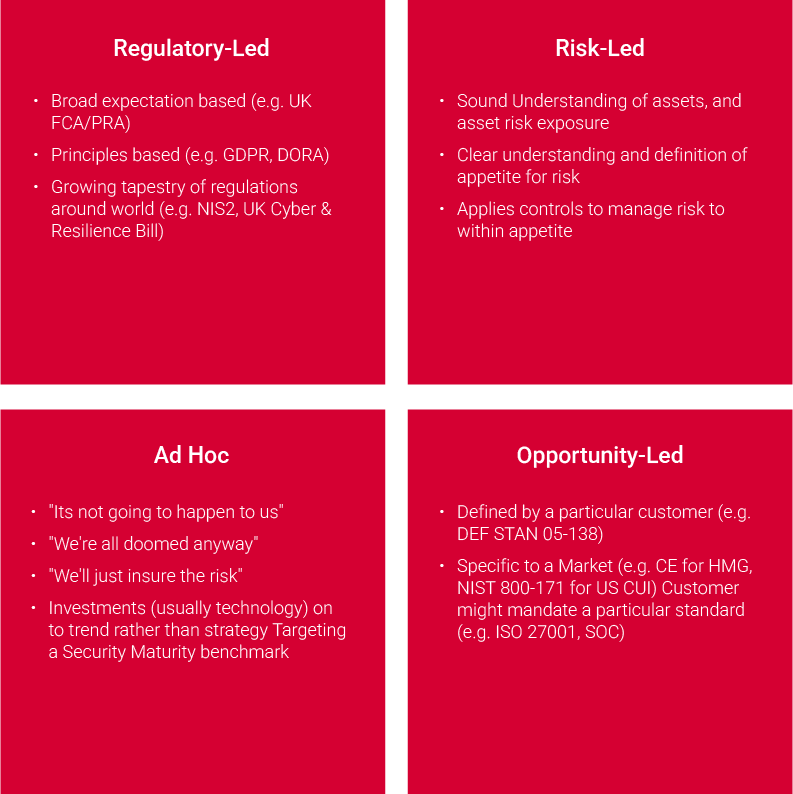
What’s your organisation’s type when it comes to cyber security? Is everything justified by the business risks, or are you hoping for the best?
Over the decades, I have found that no two businesses or organisations have taken the same approach to cybersecurity. This is neither a criticism nor a surprise. No two businesses are the same, so why would their approach to digital risk be?
However, I have found that there are some trends or clusters. In this article, I’ve distilled those observations, my understanding of the forces that drive each approach, and some indicators that may help you recognise it. I have also suggested potential advantages and disadvantages.
Ad Hoc
Let’s start with the ad hoc approach, where the organisation does what it thinks needs to be done, but without any clear rationale to determine “How much is enough?”
The Bucket of Sand Approach
At the extreme end of the spectrum is the 'Bucket of Sand' option which is characterised by the belief that 'It will never happen to us'. Your organisation may feel that it is too small to be worth attacking or has nothing of any real value. However, if an organisation has nothing of value, one wonders what purpose it serves. At the very least, it is likely to have money. But it is rare now that an organisation will not hold data and information worth stealing. Whether this data is its own or belongs to a third party, it will be a target.
I’ve also come across businesses that hold a rather more fatalistic perspective. Most of us are aware of the regular reports of nation-state attacks that are attempting to steal intellectual property, causing economic damage, or just simply stealing money. Recognising that you might face the full force of a cyber-capable foreign state is undoubtedly daunting and may encourage the view that 'We’re all doomed regardless'.
If a cyber-capable nation-state is determined to have a go at you, the odds are not great, and countering it will require eye-watering investments in protection, detection and response. But the fact is that they are rare events, even if they receive disproportionate amounts of media coverage. The majority of threats that most organisations face are not national state actors. They are petty criminals, organised criminal bodies, opportunistic amateur hackers or other lower-level actors. And they will follow the path of least resistance. So, while you can’t eliminate the risk, you can reduce it by applying good security and making yourself a more challenging target than the competition.
Following Best Practice
Thankfully, these 'Bucket of Sand' adopters are less common than ten or fifteen years ago. Most in the Ad Hoc zone will do some things but without clear logic or rationale to justify why they are doing X rather than Y.
They may follow the latest industry trends and implement a new shiny technology (because doing the business change bit is hard and unpopular). This type of organisation will frequently operate security on a feast or famine basis, deferring investments to next year when there is something more interesting to prioritise, because without business strategy guiding security it will be hard to justify. And 'next year' frequently remains next year on an ongoing basis.
At the more advanced end of the Ad Hoc zone, you will find those organisations that choose a framework and aim to achieve a specific benchmark of Security Maturity. This approach ensures that capabilities are balanced and encourages progressive improvement. However, 'How much is enough?' remains unanswered; hence, the security budget will frequently struggle for airtime when budgets are challenged. It may also encourage a one-size-fits-all approach rather than prioritising the assets at greatest risk, which would cause the most significant damage if compromised.
Regulatory-Led
The Regulatory-Led organisation is the one I’ve come across most frequently. A market regulator, such as the FCA in the UK, may set regulations. Or the regulator may be market agnostic but have responsibility for a particular type of data, such as the Information Commissioner’s Office’s interest in personal data privacy.
If regulatory compliance questions dominate most senior conversations about cyber security, the organisation is probably in this zone.
Frequently, this issue of compliance is not a trivial challenge. Most regulations don’t tend to be detailed recipes to follow. Instead, they outline the broad expectations or the principles to be applied. There will frequently be a tapestry of regulations that need to be met rather than a single target to aim for. Businesses operating in multiple countries will likely have different regulations across those regions. Even within one country, there may be market-specific and data-specific regulations that both need to be applied.
This tapestry is growing year after year as jurisdictions apply additional regulations to better protect their citizens and economies in the face of proliferating and intensifying threats. In the last year alone, EU countries have had to implement both the Digital Operational Resilience Act (DORA) and Network and Infrastructure Security Directive (NIS2), which regulate financial services businesses and critical infrastructure providers respectively.
Superficially, it appears sensible and straightforward, but in execution the complexities and limitations become clear. Some of the nuances include:
Not Everything Is Regulated
The absence of regulation doesn’t mean there is no risk. It just means that the powers that be are not overly concerned. Your business will still be exposed to risk, but the regulators or government may be untroubled by it.
Regulations Move Slowly
Cyber threats are constantly changing and evolving. As organisations improve their defences, the opposition changes their tactics and tools to ensure their attacks can continue to be effective. In response, organisations need to adjust and enhance their defences to stay ahead. Regulations do not respond at this pace. So, relying on regulatory compliance risks preparing to 'Fight the last war'.
The Tapestry Becomes Increasingly Unwieldy
It may initially appear simple. You review the limited regulations for a single region, take your direction, and apply controls that will make you compliant. Then, you expand into a new region. And later, one of your existing jurisdictions introduces an additional set of regulations that apply to you. Before you know it, you must first normalise and consolidate the requirements from a litany of different sets of rules, each with its own structure, before you can update your security/compliance strategy.
Most Regulations Talk about Appropriateness
As mentioned before, regulations rarely provide a recipe to follow. They talk about applying appropriate controls in a particular context. The business still needs to decide what is appropriate. And if there is a breach or a pre-emptive audit, the business will need to justify that decision. The most rational justification will be based on an asset’s sensitivity and the threats it is exposed to — ergo, a risk-based rather than a compliance-based argument.
Opportunity-Led
Many businesses don’t exist in heavily regulated industries but may wish to trade in markets or with customers with certain expectations about their suppliers’ security and resilience. These present barriers to entry, but if overcome, they also offer obstacles to competition.
The expectations may be well defined for a specific customer, such as DEF STAN 05-138, which details the standards that the UK Ministry of Defence expects its suppliers to meet according to a project’s risk profile.
Sometimes, an entire market will set the entry rules. The UK Government has set Cyber Essentials as the minimum standard to be eligible to compete for government contracts. The US has published NIST 800-171 to detail what government suppliers must meet to process Controlled Unclassified Information (CUI).
Businesses should conduct due diligence on their suppliers, particularly when they provide technology, interface with their systems or process their data. Regulations, such as NIS2, are increasingly demanding this level of Third Party Risk Management because of the number of breaches and compromises originating from the supply chain. Businesses may detail a certain level of certification that they consider adequate, such as ISO 27001 or a System & Organization Controls (SOC) report.
By achieving one or more of these standards, new markets may open up to a business. Good security becomes a growth enabler. But just like with regulations, if the security strategy starts with one of these standards, it can rapidly become unwieldy as a patchwork quilt of different entry requirements builds up for other markets.
Risk-Led
The final zone is where actions are defined by the risk the business is exposed to. Being led by risk in this way should be natural and intuitive. Most of us might secure our garden shed with a simple padlock but would have several more secure locks on the doors to our house. We would probably also have locks on the windows and may add CCTV cameras and a burglar alarm if we were sufficiently concerned about the threats in our area. We may even install a secure safe inside the house if we have some particularly valuable possessions. These decisions and the application of defences are all informed by our understanding of the risks to which different groups of assets are exposed.
The security decisions you make at home are relatively trivial compared to the complexity most businesses face with digital risk. Over the decades, technology infrastructures have grown, often becoming a sprawling landscape where the boundaries between one system and another are hard to determine. In the face of this complexity, many organisations talk about being risk-led but, in reality, operate in one of the other zones.
There is no reason why an organisation can’t progressively transform from an Ad Hoc, Regulatory-Led or Opportunity-Led posture into a Risk-Led one. This transformation may need to include a strategy to enhance segmentation and reduce the sprawling landscape described above. Risk-Led also doesn’t mean applying decentralised, bespoke controls on a system-by-system basis. The risk may be assessed against the asset or a category of assets, but most organisations usually have a framework of standard controls and policies to apply or choose from.
The test to tell whether an organisation genuinely operates in the Risk-Led zone is whether they have a well-defined Risk Appetite. This policy is more than just the one-liner stating that they have a very low appetite for risk. It should typically be broken down into different categories of risk or asset types; for instance, it might detail the different appetites for personal data risk compared to corporate intellectual property marked as 'In Strict Confidence'. Each category should clarify the tolerance, the circumstances under which risk will be accepted, and who is authorised to sign off.
I’ve seen some exceptionally well-drafted risk appetite policies that provide clear direction. Once in place, any risk review can easily understand the boundaries within which they can operate and determine whether the controls for a particular context are adequate.
I’ve also seen many that are so loose as to be unactionable or, on as many occasions, have not been able to find a risk appetite defined at all. In these situations, there is no clear way of determining 'How much security is enough'.
Organisations operating in this zone will frequently still have to meet regulatory requirements and individual customer or market expectations. However, this regulatory or commercial risk assessment can take the existing strategy as the starting point and review the relevant controls for compliance. That may prompt an adjustment to security in certain places. But when challenged, you can defend your strategy because you can trace decisions back to the negative outcomes you are attempting to prevent — and this intent is in everyone’s common interest.
Conclusions
Which zone does your business occupy? It may exist in more than one — for instance, mainly aiming for a specific security maturity in the Ad Hoc zone but reinforced for a particular customer. But which is the dominant zone that drives plans and behaviour? And why is that? It may be the right place for today, but is it the best approach for the future?
Apart from the 'Bucket of Sand' approach, each has pros and cons. I’ve sought to stay balanced in how I’ve described them. However, the most sustainable approach is one driven by business risk, with controls that mitigate those risks to a defined appetite.
Regulatory compliance will probably constitute some of those risks, and when controls are reviewed against the regulatory requirements, there may be a need to reinforce them. Also, some customers may have specific standards to meet in a particular context. However, the starting point will be the security you believe the business needs and can justify before reviewing it through a regulatory or market lens.
If you want to discuss how you can improve your security, reduce your digital risk, and face the future with confidence, get in touch with Tom Burton, Senior Partner - Cyber Security, using the below form.
Contact - SME Cyber Security article
Subscribe to our Newsletter
Blog Subscribe
SHARE CONTENT