
Cambridge Research: Crossing the Agentic Chasm

KEY TAKEAWAYS
- Operators scaling from a handful of live agents towards TM Forum Autonomous Networks Level 4 face a 'chasm' that early-stage use cases and business cases do not prepare them for.
- Before scaling, operators should step back and build a longer-term autonomy roadmap that tests where the business model may fail, where the major risks sit, and what humans and agents working together will demand culturally and technically.
- Scaling agentic systems safely depends on a risk register with a senior owner, because managing risk stretches well beyond a good agent harness and some extra governance.
- The hardest question is where the money is, as falling token costs are likely to be offset by the far greater token volumes agentic systems consume.
2 MIN READ
Research Preview
This is a short article based on one of the technical reports produced by Cambridge AIQ, the research and analysis arm of Cambridge Management Consulting. To find out more and to purchase any of reports, click here.
Crossing the Agentic Chasm
As operators move from deploying a handful of agents to creating TM Forum Autonomous Networks Level 4 processes, they face significant headwinds. To overcome these, they require a solid long-term plan, a clear understanding of the risks they face, and a technical and strategic roadmap.
Today, operators have live agents in production and a vision to move forward with autonomy. We see them needing to take a five-stage journey.
The Five Stages of the Agentic Systems Roadmap
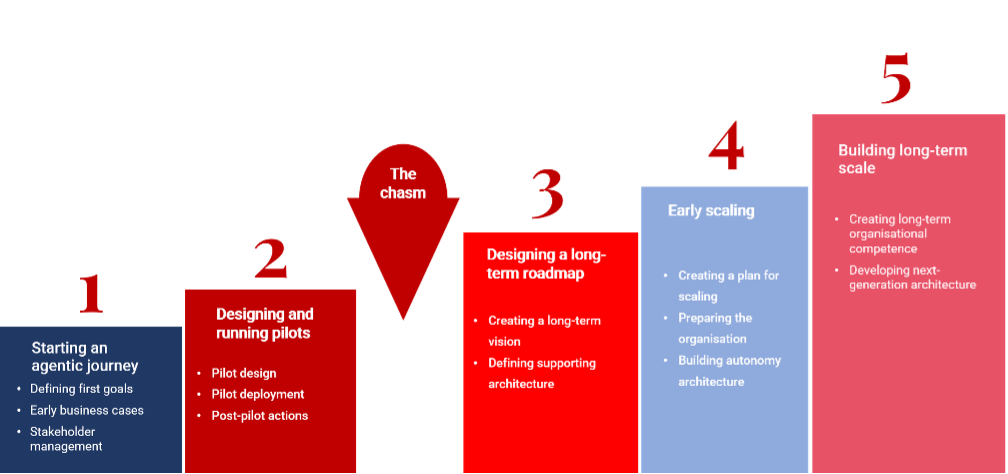
In the early stages, the roadmap resembles that of many other operator transformation programmes: identify a strong initial use case, establish a credible business case, and define the capabilities and controls needed for deployment.
However, as organisations scale these agentic systems, they uncover a broad range of challenges and a chasm they must tackle before they can deliver the dynamic systems of next level autonomy.
What are their next moves?
- First, they need to take a step back and spend time developing a longer-term autonomy roadmap. This is Stage 3 and should include building understanding around some of the more difficult agentic issues. Typical questions at this stage include: Are there places where the business model will not work? Where are the major pain points and risks, and do we have a plan to manage them? What does it mean to have agents and humans working together, and what do we need to do both culturally and technically?
- They should then use the thinking from Stage 3 to inform early actions in Stage 4 (the scaling of agentic systems). Stage 4 brings a lot of complexity, and the decisions made in Stage 3 should help build a plan that navigates it.
Some of the early activities in Stage 4 should include:
Create a risk register: Managing risk stretches well beyond a decent agent harness and some additional governance. Track the risks, the proposed remedies and progress towards resolving them, with a senior owner accountable for keeping the whole picture in view.
Focus on the knowledge plane: The industry is in the early days of building suitable knowledge, and many questions remain: How do we build a suitable ontology? Do we need a single knowledge graph or will multiple smaller deployments support early requirements?
Work out where the money is: This is the difficult bit. A long-term business model should set realistic expectations for new revenue and address topics such as the expected decreases in token cost which are likely to be offset by the rise in tokens needed by agentic systems.
Our report Creating a Roadmap to Agentic Maturity provides:
- A summary of key activities for Stage 1–3
- Diving more deeply into the required actions in Stage 4, where scaling begins
- Providing a skeleton framework for working in Stage 4, so that those managing agentic projects can understand the breadth of areas where they need to create strategy
To find out more or purchase the report,
click here.
About Us
Cambridge Management Consulting (Cambridge MC) is an international consulting firm that helps companies of all sizes have a better impact on the world. Founded in Cambridge, UK, initially to help the start-up community, Cambridge MC has grown to over 200 consultants working on projects in 25 countries. Our capabilities focus on supporting the private and public sector with their people, process and digital technology challenges.
What makes Cambridge Management Consulting unique is that it doesn’t employ consultants – only senior executives with real industry or government experience and the skills to advise their clients from a place of true credibility. Our team strives to have a highly positive impact on all the organisations they serve. We are confident there is no business or enterprise that we cannot help transform for the better.
Cambridge Management Consulting has offices or legal entities in Cambridge, London, New York, Paris, Dubai, Singapore and Helsinki, with further expansion planned in future.
Contact Form
Subscribe to our Newsletter
Blog Subscribe
SHARE CONTENT